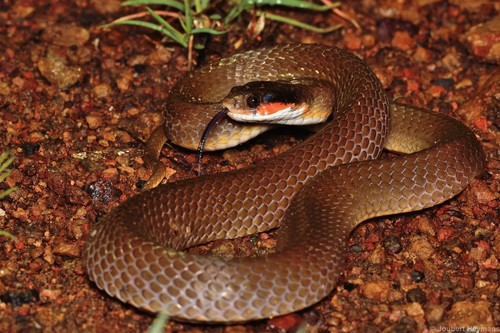
Red-lipped Snake
Crotaphopeltis hotamboeia
The Red-lipped Snake is Africa's most famous garden 'herald,' known for its striking colorful lips and its feisty, cobra-like defensive posture.
Quick Identification
Size
45–70 cm (18–28 inches) on average, occasionally reaching up to 100 cm (39 inches)
Colors
Dark olive, grey, or black body with fine white speckles; distinctive red, orange, or yellow upper lip; iridescent blue-black head; creamy-white belly
Key Features
- Bright red or orange upper labial scales ('lips')
- Iridescent blackish head distinct from the neck
- White speckles often arranged in faint cross-bars
- Flattened head display when threatened
When You’ll See Them
Geographic range
Where Does the Red-lipped Snake Live?
The Red-lipped Snake is a widespread species native to Sub-Saharan Africa. It can be found from the southern tip of South Africa, moving northwards through East Africa into Ethiopia, and across to West African nations like Nigeria and Ghana. It is exceptionally common in suburban environments across its range, provided there is enough moisture to support a healthy population of frogs.
Basemap © OpenStreetMap contributors
Behavior
The Red-lipped Snake, also known as the Herald Snake, is a common nocturnal reptile known for its impressive but largely harmless defensive display. When it feels threatened, it flattens its head into a triangular shape and strikes vigorously with its mouth open, mimicking a more dangerous venomous snake. Despite this feisty attitude, its venom is mild and generally has no effect on humans.
These snakes are solitary and terrestrial, spending their daylight hours hidden under rocks, logs, or garden compost heaps. They are highly active after dark, especially during or after rain when their primary prey is most active. They are excellent swimmers and are frequently found near water sources where amphibians congregate.
EverydayEarth exclusive
Camera Tips
To capture a Red-lipped Snake on camera, focus your efforts on damp, low-lying areas. Placing a camera near a garden pond, a leaky outdoor tap, or a pile of damp leaf litter is highly effective, as these are prime hunting grounds for their amphibian prey. Because they are terrestrial, the camera should be mounted very low to the ground—ideally no more than 10 centimeters (4 inches) high—with a slight downward tilt.
Since these snakes are strictly nocturnal, infrared (IR) capability is essential. Set your camera to take short video clips (10–15 seconds) rather than still photos. This helps in identification, as you can see the snake's characteristic movement and the way it flicks its tongue. Use a high-sensitivity trigger setting, as cold-blooded reptiles have a low thermal signature and can be harder for PIR sensors to detect than warm-blooded mammals.
Be mindful of the 'white-out' effect on infrared cameras. The scales of a Red-lipped Snake can be quite iridescent and reflective; if the snake passes too close to the IR LEDs, the image may overexpose. To prevent this, place the camera about 1.5 to 2 meters away from a known 'runway' or pond edge where you expect them to pass. Monitoring during the rainy season will significantly increase your chances of a sighting.
Similar Species
Species that look similar or are commonly confused with Red-lipped Snake.
Frequently Asked Questions
Record Red-lipped Snake at your habitat
Connect a camera to start building your own species record — AI identifies every visitor automatically.