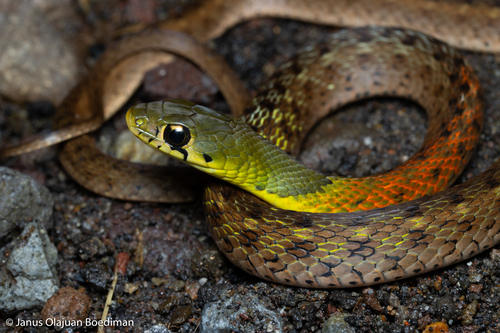
Red-necked Keelback
Rhabdophis subminiatus
A dazzling resident of Asian wetlands, the Red-necked Keelback is a rare biological marvel—both venomous and poisonous, with a brilliant orange 'collar' that demands attention.
Quick Identification
Size
70-90 cm (27-35 inches) on average, though some individuals reach 130 cm (51 inches)
Colors
Olive-green to brownish body with a vibrant red or orange patch on the upper neck; yellow and black markings around the eyes and labial scales
Key Features
- Brilliant red or orange 'collar' on the neck
- Strongly keeled (ridged) scales giving a textured look
- Large eyes with round pupils and dark streaks below
- Slender but muscular build
When You’ll See Them
Geographic range
Where Does the Red-necked Keelback Live?
This striking reptile is native to the tropical and subtropical regions of South and Southeast Asia. Its core range spans from Northeast India and Nepal across the Indochinese Peninsula, including Thailand, Vietnam, Laos, and Cambodia, reaching as far north as southern China. It is also commonly found throughout the islands of Indonesia and Malaysia, thriving in almost any habitat where freshwater and amphibians are plentiful.
Basemap © OpenStreetMap contributors
Behavior
The Red-necked Keelback is a fascinating diurnal serpent known for its unique defensive biology. It is one of the few creatures on Earth that is both venomous and poisonous. It possesses rear fangs that deliver a potent anticoagulant venom to its prey, but it also features specialized nuchal glands on the back of its neck. These glands store toxins sequestered from the poisonous toads the snake eats, which it can then release as a secondary defense against predators.
Generally shy and non-aggressive toward humans, this species prefers to flee when it senses vibrations. However, when cornered, it may flatten its neck—much like a cobra—to display its bright warning colors or arch its back to present its poisonous glands to the threat. They are highly active during the day, especially in the morning hours, as they hunt through leaf litter and shallow water for their favorite amphibian meals.
EverydayEarth exclusive
Camera Tips
To successfully capture a Red-necked Keelback on your backyard camera, you must focus on 'edge habitats.' These snakes love the transition zone between water and land. Position your camera near the edge of a garden pond, a drainage ditch, or a damp patch of mulch where frogs tend to congregate. Because these snakes are ground-dwellers, mount your camera very low—ideally only 10 to 15 centimeters off the ground—and angle it slightly downward to catch them as they glide through the grass.
Since these are diurnal hunters, ensure your camera is set to trigger during daylight hours. They are most active when the sun is out but the ground is still moist. You won't have much luck with traditional food baits, but you can create a 'natural lure' by maintaining a small water feature that attracts frogs and toads. A flat, sun-drenched rock placed near a water source can also serve as a basking platform where the snake might pause to warm up, giving you a perfect opportunity for a still photo.
Use a fast trigger speed if your camera allows it; while they are often slow-moving when foraging, they can strike or flee with surprising speed. During the rainy season, these snakes become much more mobile and are frequently seen in suburban yards. If you live in their range, check your SD cards more frequently after a heavy rain, as the increase in amphibian activity almost always brings the Keelbacks out for a hunt.
Similar Species
Species that look similar or are commonly confused with Red-necked Keelback.
Frequently Asked Questions
Record Red-necked Keelback at your habitat
Connect a camera to start building your own species record — AI identifies every visitor automatically.