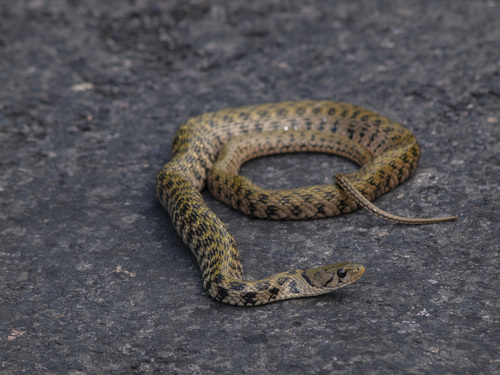
Yellow-spotted Keelback
Fowlea flavipunctata
The Yellow-spotted Keelback is a vibrant, semi-aquatic resident of Asian wetlands and garden ponds. Known for its signature golden spots and active daytime hunting, it is a fascinating neighbor for anyone with a love for backyard water features.
Quick Identification
Size
Typically 60-100 cm (24-40 inches) in length; slender to moderate build
Colors
Olive-brown, grey, or dark green base color with rows of small, distinct yellow or cream-colored spots along the lower flanks; belly is pale yellow or white
Key Features
- Rows of cream or yellow spots along the sides
- Strongly keeled (ridged) scales giving a rough texture
- Black 'teardrop' streak running diagonally below each eye
- Semi-aquatic build with eyes positioned slightly on top of the head
When You’ll See Them
Geographic range
Where Does the Yellow-spotted Keelback Live?
This species is native to the tropical and subtropical regions of East and Southeast Asia. Its core range spans across Thailand, Vietnam, Cambodia, Laos, and southern China, extending westward into Myanmar and Bangladesh and southward into Peninsular Malaysia. It is a lowland specialist, thriving in human-altered landscapes such as irrigated agricultural fields and urban waterways throughout the Indochina peninsula.
Basemap © OpenStreetMap contributors
Behavior
In terms of temperament, these snakes are generally shy and prefer to flee into the water or thick reeds at the first sign of danger. While they are non-venomous and pose no threat to humans, they may flatten their bodies and strike if they feel cornered or handled. In suburban environments, they are remarkably adaptable and are frequently found in garden ponds, drainage canals, and even swimming pools, where they serve as excellent natural pest controllers by managing frog populations.
EverydayEarth exclusive
Camera Tips
To successfully capture a Yellow-spotted Keelback on your backyard camera, placement is everything. Focus your camera on the 'transition zones' where water meets land. Ideal spots include the muddy banks of a garden pond, a flat basking stone, or a gap in aquatic vegetation. Because these snakes are relatively small and stay low to the ground, mount your camera just 4 to 6 inches above the surface. Angle the lens slightly downward to ensure you don't miss the snake's low-profile movement.
Since these are diurnal hunters, ensure your camera's daytime trigger speed is set to its fastest setting. Snakes move with a fluid, continuous motion that can sometimes trick slower sensors. If your camera has a 'Time Lapse' mode, consider setting it to take a photo every 30 seconds during the mid-morning hours (8 AM to 11 AM); this is when the snakes are most likely to be basking or hunting frogs and may not trigger the PIR sensor if they move too slowly.
You don't need artificial lures for this species; instead, 'lure' the prey. A garden pond with a healthy population of frogs is a natural magnet for Keelbacks. If you have a specific rock or log that stays in the sun for several hours, this is the perfect 'stage' for your camera. These snakes love to sunbathe to digest their meals, providing the best opportunity for a clear, high-resolution identification photo.
Pay close attention to the weather. The best footage is often captured immediately after a heavy rain shower when frogs are most active. The increased humidity and prey activity draw the Keelbacks out of hiding. Make sure your camera lens is treated with an anti-fog coating, as the humid environments these snakes prefer can often cause condensation on the glass during the morning transition.
Similar Species
Species that look similar or are commonly confused with Yellow-spotted Keelback.
Frequently Asked Questions
Record Yellow-spotted Keelback at your habitat
Connect a camera to start building your own species record — AI identifies every visitor automatically.