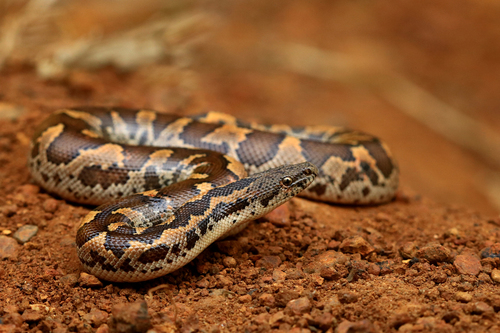
Rough-scaled Sand Boa
Eryx conicus
The Rough-scaled Sand Boa is a subterranean specialist known for its unique armor-like scales and remarkable mimicry. A quiet guardian of the garden, it plays a vital role in controlling rodent populations from beneath the soil.
Quick Identification
Size
Typically 50–90 cm (20–35 inches) in length; females are significantly larger and heavier than males, occasionally reaching 100 cm.
Colors
Yellowish-brown, grey, or tan ground color with irregular dark brown or reddish-brown blotches that often fuse. The belly is white or cream-colored.
Key Features
- Extremely keeled, 'rough' scales especially toward the tail
- Short, blunt tail that resembles the head
- Stocky, cylindrical body with a head not distinct from the neck
- Small eyes with vertical pupils
When You’ll See Them
Geographic range
Where Does the Rough-scaled Sand Boa Live?
The Rough-scaled Sand Boa is native to the southern portion of the Asian continent. Its core range covers the vast majority of India, extending from the foothills of the Himalayas down to the southern tip of the peninsula. Beyond India, it is commonly found across Pakistan, Sri Lanka, eastern Afghanistan, and parts of Nepal and Bangladesh. Because it adapts well to human-altered landscapes, it is a frequent resident of suburban gardens and farms throughout these regions, provided the soil remains soft enough for burrowing.
Basemap © OpenStreetMap contributors
Behavior
The Rough-scaled Sand Boa is a master of subterranean living, spending much of its life just beneath the surface of loose soil or sand. It is a patient ambush predator, often lying in wait with only its snout or eyes exposed, ready to strike at passing prey. Despite being a member of the boa family, it is relatively small and slow-moving, relying on its incredible camouflage and mimicry of the venomous Russell's Viper to deter predators.
While generally docile and non-venomous, this species can be quite defensive if handled, often jerking its body or attempting to strike if it feels cornered. In a backyard setting, they are solitary and secretive, often going unnoticed for years even in high-density areas. They are primarily crepuscular or nocturnal, becoming most active as the ground cools after sunset.
EverydayEarth exclusive
Camera Tips
Capturing a Rough-scaled Sand Boa on camera requires a strategy focused on ground-level activity. Because these snakes rarely leave the earth's surface, your camera must be mounted extremely low—no more than 3 to 5 inches off the ground. Aim the lens across a patch of loose, sandy soil or along the edge of a garden wall or building foundation, which these snakes often use as travel corridors.
Since they are ectothermic and relatively slow-moving, standard PIR (Passive Infrared) sensors might struggle to trigger. If your camera allows for 'Time Lapse' mode, set it to take a photo every 1–2 minutes during the twilight hours of 6 PM to 9 PM. If using motion detection, set the sensitivity to its highest level to catch the subtle movement of a snake sliding through the leaf litter.
Focus on 'micro-habitats' like the edges of compost heaps or wood piles, which attract the rodents and lizards the boa hunts. These snakes are most likely to emerge from the ground following a light rain or during the high humidity of the monsoon season, as the moisture makes the soil easier to navigate and brings prey out of hiding. Using a camera with high-quality infrared LEDs is essential, as their mottled pattern is designed to blend perfectly with the shadows at night.
Similar Species
Species that look similar or are commonly confused with Rough-scaled Sand Boa.
Frequently Asked Questions
Record Rough-scaled Sand Boa at your habitat
Connect a camera to start building your own species record — AI identifies every visitor automatically.