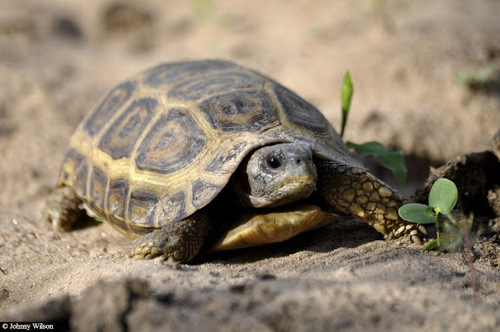
Speke's Hinge-back Tortoise
Kinixys spekii
The Speke's Hinge-back Tortoise is a remarkable survivor of the African bushveld, featuring a unique 'armored door' on its shell. Watch for this agile climber near rocky kopjes during the first rains of the summer.
Quick Identification
Size
Carapace length 16–20 cm (6.3–7.9 inches); weight 500–1,000 grams (1.1–2.2 lbs)
Colors
Yellowish-brown or olive-toned carapace with dark radiating rays or concentric patterns on the scutes; plastron is typically pale yellow with dark blotches.
Key Features
- Distinct flexible hinge on the rear of the upper shell
- Noticeably flattened carapace compared to other hinge-backs
- Five claws on each front foot
- Elongated, narrow shell shape
When You’ll See Them
Geographic range
Where Does the Speke's Hinge-back Tortoise Live?
Speke's Hinge-back Tortoise is widely distributed across the savannas and woodlands of East and Southern Africa. Its native range is anchored in Zimbabwe, South Africa, and Mozambique, extending northward through Malawi and Zambia into Tanzania and southern Kenya. It is a specialist of the subtropical 'bushveld' regions, often associated with rocky outcrops where it can find the secure retreats it needs to survive the dry season.
Basemap © OpenStreetMap contributors
Behavior
This tortoise is highly seasonal in its activity, timed specifically to the arrival of summer rains. During the dry winter months, it enters a state of estivation, remaining dormant in cool, underground refuges to conserve moisture. When the rains arrive, they become much more active and can be seen moving surprisingly quickly across the savanna floor or even climbing over low rocky obstacles. They are generally solitary creatures and are quite shy, often freezing in place if they sense movement nearby.
EverydayEarth exclusive
Camera Tips
Seasonality plays a massive role in your success rate. In Southern and East Africa, these tortoises are nearly invisible during the dry winter months. Your best chance for a 'hero shot' is immediately following a heavy rainstorm in early summer. The moisture triggers an emergence as they seek out freshly sprouted fungi and puddles to drink from. Setting your camera near a natural depression that holds water after rain is a high-yield strategy.
Because tortoises move slowly, standard motion triggers can sometimes be finicky. If your camera allows it, use a combination of high-sensitivity motion detection and a 'Time Lapse' mode set to 5 or 10-minute intervals during the morning hours (7 AM to 11 AM). This ensures you catch them even if they are stationary for long periods while basking. For lures, a few slices of overripe melon or tomato can be highly effective in a garden setting, but be mindful that this may also attract nocturnal scavengers like porcupines or honey badgers.
Similar Species
Species that look similar or are commonly confused with Speke's Hinge-back Tortoise.
Frequently Asked Questions
Record Speke's Hinge-back Tortoise at your habitat
Connect a camera to start building your own species record — AI identifies every visitor automatically.