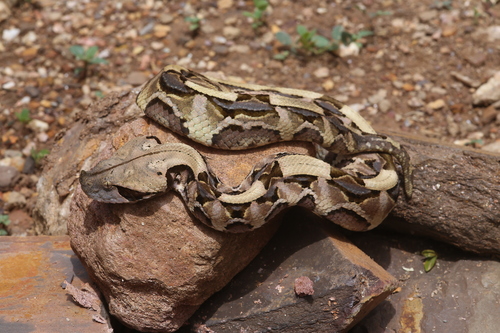
Western Gaboon Viper
Bitis rhinoceros
The Western Gaboon Viper is a masterpiece of natural engineering, boasting the longest fangs and the most sophisticated camouflage in the snake world. A silent guardian of the West African rainforest floor, this massive viper is as beautiful as it is misunderstood.
Quick Identification
Size
Typically 1.2–1.8 m (4–6 ft) in length; can weigh up to 20 kg (45 lbs), making it one of the world's heaviest vipers.
Colors
A complex mosaic of tan, purple, pink, and brown geometric shapes; the head is pale with a thin, dark center line and two prominent horns on the snout.
Key Features
- Two large, horn-like scales on the tip of the snout
- Massive, triangular head distinct from the neck
- Intricate leaf-mimicry camouflage pattern
- Longest fangs of any snake, reaching up to 5 cm (2 inches)
When You’ll See Them
Geographic range
Where Does the Western Gaboon Viper Live?
Native to the tropical regions of West Africa, the Western Gaboon Viper is primarily found in the moist forest belt of the Upper Guinean forests. Its core range extends from Guinea and Sierra Leone through Liberia and Ivory Coast, reaching as far east as Ghana and Togo. While they are strictly forest-dependent, they are increasingly found in old-growth plantations and forest fragments that maintain a thick layer of leaf litter.
Basemap © OpenStreetMap contributors
Behavior
The Western Gaboon Viper is a master of patience and the ultimate ambush predator. Unlike many snakes that actively hunt, this species will remain motionless for days, perfectly camouflaged among the leaf litter on the forest floor, waiting for a small mammal or bird to pass within striking distance. Despite their formidable size and potent venom, they are famously docile and slow-moving, rarely striking at humans unless severely provoked or stepped upon.
When they do strike, it is with incredible speed and power. Unlike most vipers that strike and release, the Gaboon Viper often holds onto its prey, injecting a massive volume of venom. They are largely solitary and nocturnal, though they can be found basking in filtered sunlight near forest openings during the day. In areas with human activity, they are most dangerous because their camouflage is so effective that they are nearly impossible to see before it is too late.
EverydayEarth exclusive
Camera Tips
Capturing a Western Gaboon Viper on camera requires a strategy focused on micro-habitats. Look for areas with deep, undisturbed leaf litter near the base of large buttress-root trees or along established rodent runs. Because these vipers are ambush predators, they may stay in the exact same spot for over a week; if you find one, it is a perfect candidate for a long-term time-lapse or high-sensitivity video setup.
Set your camera at a very low height—no more than 10 to 15 centimeters (4-6 inches) off the ground—and angle it parallel to the forest floor. Standard PIR sensors can sometimes struggle to detect cold-blooded reptiles against a warm background, so use a camera with high sensitivity settings or one that supports external triggers. Because their movement is infrequent but fast when it happens, a fast trigger speed (under 0.3 seconds) is essential to catch a strike or a slow crawl.
While we never recommend using live bait, placing your camera near natural attractants like fallen fruit can be effective. The fruit attracts rodents, and where there are rodents, there is likely a Gaboon Viper waiting. Nighttime captures will be your most common result, so ensure your camera has a high-quality 'no-glow' or black IR flash to avoid washing out the snake's intricate patterns or startling other wildlife in the area.
Similar Species
Species that look similar or are commonly confused with Western Gaboon Viper.
Frequently Asked Questions
Record Western Gaboon Viper at your habitat
Connect a camera to start building your own species record — AI identifies every visitor automatically.