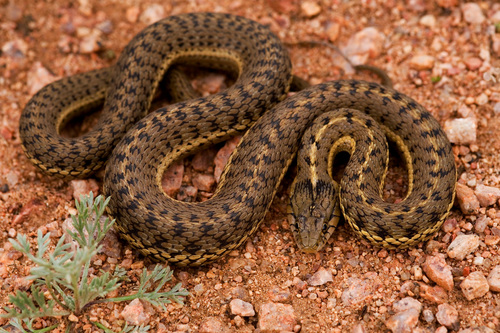
Western Terrestrial Garter Snake
Thamnophis elegans
A master of adaptation, the Western Terrestrial Garter Snake is a common and fascinating visitor to Western backyards. Known for its striking stripes and generalist diet, this hardy reptile thrives everywhere from mountain peaks to suburban gardens.
Quick Identification
Size
18–43 inches (46–110 cm) in length; weight typically ranges from 50–150 grams
Colors
Variable background of gray, brown, or greenish-black; typically features three light-colored stripes (yellow, orange, or white) with dark checkered spotting between them
Key Features
- Three distinct longitudinal stripes
- Dark checkered pattern between stripes
- Keeled scales giving a rough texture
- Head is noticeably wider than the neck
When You’ll See Them
Geographic range
Where Does the Western Terrestrial Garter Snake Live?
Native to the western half of North America, the Western Terrestrial Garter Snake occupies a vast territory stretching from southwestern Canada through most of the western United States and into northern Baja California, Mexico. Its core range includes the Rocky Mountains, the Great Basin, and the Pacific Coast, where it thrives across a multitude of ecosystems. This widespread distribution makes it one of the most commonly encountered snakes for hikers and backyard observers throughout the American West.
Basemap © OpenStreetMap contributors
Behavior
The Western Terrestrial Garter Snake is a highly adaptable and active diurnal reptile. Unlike some of its relatives that stay strictly near water, this species is frequently found far from permanent water sources, foraging through grasslands and forest floors. They are primarily solitary but may congregate in large numbers at communal 'hibernacula' or denning sites during the winter months to survive freezing temperatures.
When threatened, these snakes usually seek a quick escape into dense vegetation or water. If cornered or handled, they may release a foul-smelling musk from their cloaca as a defense mechanism or strike and bite, though they are generally harmless to humans. They are curious hunters, often seen 'tasting' the air with their flicking tongues to track the scent of prey or potential mates.
EverydayEarth exclusive
Camera Tips
To capture high-quality footage of a Western Terrestrial Garter Snake, you must think low. These snakes spend the vast majority of their time on the ground, so position your camera just 2 to 5 inches above the soil. A slight downward angle is best to capture the intricate patterns on their back. Focus on 'pinch points' in your yard, such as the edge of a rock wall, the base of a fence, or along the margin of a garden bed, as snakes prefer to travel along cover rather than crossing open ground.
Sun-drenched basking spots are your best bet for daytime activity. Look for flat rocks or logs that receive early morning sun. Since snakes are ectothermic, they need to warm up before they can hunt. Placing a camera near a small backyard pond or water feature can also be highly effective, as these snakes are drawn to water both for hydration and to hunt for amphibians. Avoid using traditional lures or baits, as snakes are attracted to movement and scent rather than static food; instead, ensure your backyard has plenty of leaf litter and mulch which attracts their natural prey like slugs and worms.
For the best results, use a camera with a high trigger speed and a short focal distance, as snakes can move surprisingly fast. Set your camera to record short video clips (10-15 seconds) rather than still images to better see their movement and tongue-flicking behavior. If your camera allows, adjust the PIR sensitivity to 'High' to ensure it triggers for smaller, cold-blooded animals that may not generate a large heat signature compared to the surrounding environment.
Similar Species
Species that look similar or are commonly confused with Western Terrestrial Garter Snake.
Frequently Asked Questions
Record Western Terrestrial Garter Snake at your habitat
Connect a camera to start building your own species record — AI identifies every visitor automatically.