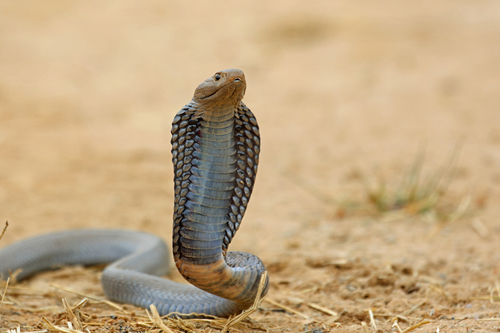
Black-necked Spitting Cobra
Naja nigricollis
A master of defense with the ability to spray venom with pinpoint accuracy, the Black-necked Spitting Cobra is a fascinating and misunderstood garden visitor across Africa.
Quick Identification
Size
1.2 to 2.2 metres (3.9 to 7.2 feet); weight typically 1 to 3 kg (2.2 to 6.6 lbs)
Colors
Slate grey, olive-brown, or jet black upper body; throat features 1-2 broad black bands often contrasted against a salmon-pink or reddish-orange underside
Key Features
- Broad black bands on the throat
- Modified fangs with forward-facing discharge holes
- Matte scales rather than glossy
- Wide hood when threatened
When You’ll See Them
Geographic range
Where Does the Black-necked Spitting Cobra Live?
This iconic cobra is native to the vast and varied landscapes of Sub-Saharan Africa. Its core range stretches from the semi-arid regions of Senegal and Mauritania in the West, across the central tropical belts, and down into the southern reaches of Angola and Namibia. It is a highly successful resident in countries like Nigeria, Kenya, and Tanzania, where it thrives in both wilderness areas and human-dominated agricultural landscapes.
Basemap © OpenStreetMap contributors
Behavior
The Black-necked Spitting Cobra is a remarkably adaptable and intelligent predator. Unlike most snakes that rely solely on biting for defense, this species has evolved the ability to 'spit' its venom. By forcing venom through specialized fangs, it can accurately target the eyes of a threat from several meters away. This is a purely defensive measure intended to cause temporary blindness and intense pain, giving the snake a chance to flee rather than engage in a dangerous physical struggle.
While primarily terrestrial, these cobras are proficient swimmers and occasional climbers. They are generally shy and prefer to retreat into the shadows of woodpiles, termite mounds, or thick vegetation when humans are near. However, they are frequently drawn to human settlements because of the high density of rodents, which are their primary food source. They exhibit a mix of nocturnal and crepuscular activity, becoming most active as the sun sets.
EverydayEarth exclusive
Camera Tips
To safely capture the Black-necked Spitting Cobra on camera, placement is everything. These snakes often follow 'scent trails' of rodents along the base of structures. Set your camera 6 to 12 inches off the ground, oriented parallel to a garden wall, fence line, or the edge of a dense thicket. A downward angle is preferred to capture the identifying throat markings if the snake raises its head slightly while moving.
Since these cobras are most active during the low-light hours of dawn and dusk, a camera with high-quality infrared (IR) night vision is non-negotiable. Avoid using white-flash cameras, as the sudden burst of light can trigger a defensive response or cause the snake to abandon the area immediately. Look for 'invisible' or 'no-glow' IR LEDs to ensure the snake remains undisturbed in its natural state.
You don't need to bait the snake directly, which can be dangerous; instead, focus on its prey. Placing a camera near a compost heap, woodpile, or bird feeder where mice and rats frequent will naturally increase your chances of recording a cobra on the hunt. Ensure your camera is set to a high trigger speed or video mode, as while they may move slowly when relaxed, they can transit a frame very quickly when they are on a mission.
Similar Species
Species that look similar or are commonly confused with Black-necked Spitting Cobra.
Frequently Asked Questions
Record Black-necked Spitting Cobra at your habitat
Connect a camera to start building your own species record — AI identifies every visitor automatically.