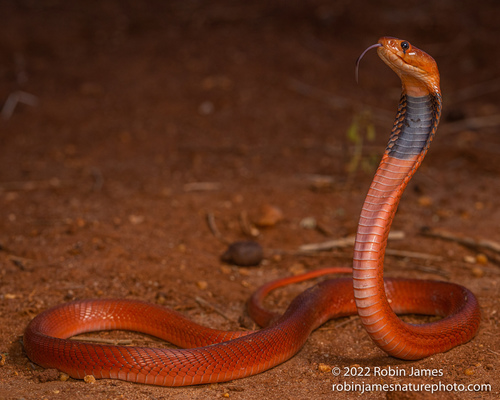
Red Spitting Cobra
Naja pallida
A masterpiece of the African drylands, the Red Spitting Cobra is as beautiful as it is dangerous. With its striking salmon-red scales and pinpoint defensive accuracy, it is a top-tier predator of the savanna.
Quick Identification
Size
Typically 0.7 to 1.2 metres (2.3 to 3.9 feet) in length, though exceptional specimens can reach 1.5 metres (4.9 feet).
Colors
Distinctive salmon-pink, bright red, or orange-red body; juveniles often feature a prominent black throat band that may fade with age.
Key Features
- Vibrant reddish to salmon-pink coloration
- Broad, slightly flattened head with large eyes
- Black teardrop-shaped markings below the eyes
- Narrow hood compared to other cobra species
When You’ll See Them
Geographic range
Where Does the Red Spitting Cobra Live?
The Red Spitting Cobra is a quintessential resident of the arid and semi-arid regions of East and Northeast Africa. Its core range spans across Kenya and Tanzania, extending northward through the dry corridors of Ethiopia, Somalia, and southern Egypt. While it thrives in the hot, dry lowlands of the Horn of Africa, it is also frequently encountered in agricultural areas and suburban outskirts where human-altered landscapes provide reliable food and water.
Basemap © OpenStreetMap contributors
Behavior
The Red Spitting Cobra is a largely nocturnal and terrestrial snake, though juveniles may be seen hunting during the day. It is famously defensive; when threatened, it rears up and spreads its narrow hood, but its primary defense is the ability to 'spit' or spray venom at the eyes of an intruder with remarkable accuracy from up to 2.5 metres away. This venom is a potent cytotoxin that causes immediate pain and can lead to permanent blindness if not washed away quickly.
Despite its fearsome reputation, this species is relatively shy and prefers to flee from human contact. It is a solitary hunter that uses its keen sense of smell and heat-sensing abilities to track prey through the arid landscapes of East Africa. In suburban environments, they are often drawn to human dwellings in search of water or the rodents and amphibians that thrive near garden irrigation.
EverydayEarth exclusive
Camera Tips
To capture the Red Spitting Cobra on camera, placement is everything. Focus your camera on 'travel corridors' such as the edges of garden walls, fallen logs, or the base of rocky outcrops where snakes feel secure moving. Set the camera as low to the ground as possible—ideally just 10-15 centimeters high—and angle it slightly upward to capture the snake's head and hood if it rears up. Because these snakes are cold-blooded, use a camera with high-sensitivity PIR (passive infrared) sensors or consider time-lapse mode, as traditional motion triggers can sometimes miss the subtle heat signature of a reptile.
In arid environments, water is the ultimate lure. A shallow birdbath or a leaking irrigation pipe can act as a magnet for Red Spitting Cobras, especially during the dry season. If you are specifically targeting this species for research, the scent of a rodent (using used pet store bedding in a perforated container) can be a highly effective non-toxic attractant. Be sure to place the bait in a spot that forces the snake to cross the camera’s focal plane.
Safety is paramount when servicing cameras in areas where this species is present. Always wear wrap-around safety glasses or a face shield when approaching a camera at ground level, as a resident cobra may be resting nearby and could spray venom toward your face. Check the immediate area with a long stick before reaching down to change batteries or SD cards. For the best shots, use a camera with 'No-Glow' black IR LEDs to avoid startling the snake during its nocturnal hunts.
Similar Species
Species that look similar or are commonly confused with Red Spitting Cobra.
Black-necked Spitting Cobra
Larger and typically olive-grey to black in color, lacks the vibrant red-orange hue.
Mozambique Spitting Cobra
Slate-grey or olive-brown body with a salmon-pink belly and prominent black bars on the throat.
Cape Cobra
Varies in color from yellow to mahogany but lacks the ability to spit venom and is found in Southern Africa.
Frequently Asked Questions
Record Red Spitting Cobra at your habitat
Connect a camera to start building your own species record — AI identifies every visitor automatically.