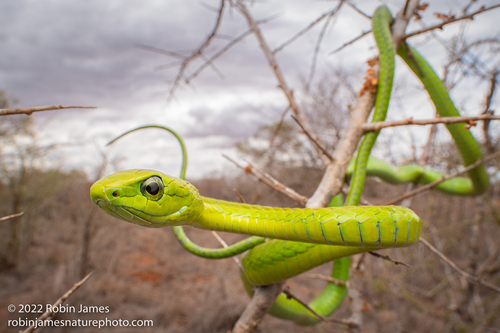
Boomslang
Dispholidus typus
A master of camouflage and the undisputed king of the canopy, the Boomslang is Africa’s most fascinating arboreal snake. With its massive eyes and gentle disposition, it proves that even the most venomous creatures can be elegant and shy neighbors.
Quick Identification
Size
Average length of 1 to 1.6 metres (3.3 to 5.2 feet), with large specimens reaching up to 2 metres (6.6 feet). Very slender build.
Colors
Highly sexually dimorphic: Males are often bright green, yellow, or even black with yellow bellies. Females are typically a dull olive-brown or grey.
Key Features
- Exceptionally large eyes with round pupils
- Short, blunt head distinct from the neck
- Heavily keeled (ridged) scales
- Defensive behavior involves inflating the neck like a balloon
When You’ll See Them
Geographic range
Where Does the Boomslang Live?
The Boomslang is widely distributed across the African continent south of the Sahara Desert. Its core range extends from the southern tip of South Africa through East African nations like Kenya and Tanzania, and across the central tropical regions to West African countries like Nigeria and Senegal. It is a resident species across this vast territory, thriving in diverse environments from coastal thickets to high-altitude woodland.
Basemap © OpenStreetMap contributors
Behavior
The Boomslang is a master of the canopy, spending the vast majority of its life in trees and shrubs. Despite being one of Africa's most venomous snakes, it is famously shy and reclusive, preferring to flee or freeze in place when disturbed rather than strike. When cornered, it performs a characteristic defensive display by inflating its neck like a balloon to appear larger and more intimidating, occasionally showing off the dark skin between its scales.
As a diurnal hunter, it relies heavily on its keen eyesight—which is superior to almost all other snakes—to track movement in the branches. While they are solitary and avoid human contact, they are often found in suburban gardens with mature trees, where they may be mistaken for harmless green snakes until their distinctive eye shape or defensive puffing is noticed. They are rear-fanged, meaning they must bite and 'chew' slightly to inject their potent hemotoxic venom.
EverydayEarth exclusive
Camera Tips
Capturing a Boomslang on camera requires looking up rather than down. Unlike most trail cam subjects that move along the ground, these snakes are arboreal. Position your camera about 1.5 to 2.5 metres high, angled slightly downward to focus on a horizontal branch or a 'highway' of tangled vines where the snake is likely to travel. Look for trees that host bird nests or have a high population of chameleons, as these are natural attractants that will bring a Boomslang into the frame.
Because these snakes are slender and move with a smooth, flowing motion, they can sometimes fail to trigger standard PIR sensors. Increase your camera's sensitivity to 'High' and use a fast trigger speed (0.3s or less). If your camera supports a time-lapse mode, setting it to take a photo every 5-10 minutes during the morning hours (8 AM to 11 AM) can be an effective way to catch them basking or hunting even if they don't trigger the motion sensor.
Lighting is your best friend when identifying these reptiles. Try to place your camera so the morning sun illuminates the canopy without shining directly into the lens. The vibrant greens of a male Boomslang or the subtle textures of a female's scales are best captured in natural light. Since they are active during the day, you won't need to worry much about night vision quality, but a high-resolution sensor (20MP+) is recommended to see the distinct round pupil and keeled scales needed for a positive ID.
Lastly, keep safety in mind. While Boomslangs are not aggressive, they are highly venomous. If you are mounting a camera in a dense bush or tree known for sightings, always wear thick gloves and check the branches carefully before reaching in. Never attempt to 'bait' a Boomslang with food, as their diet is specific and natural movement in the trees is the best lure you can provide.
Similar Species
Species that look similar or are commonly confused with Boomslang.
Eastern Green Mamba
Mambas have smooth scales and an elongated 'coffin-shaped' head, whereas the Boomslang has keeled scales and much larger eyes.
Spotted Bush Snake
This harmless snake is much smaller and thinner, with black spots on the front half of its body and a flatter head profile.
Cape Cobra
While yellow or brown Boomslangs can look similar, Cape Cobras are primarily ground-dwelling and will spread a hood when threatened.
Frequently Asked Questions
Record Boomslang at your habitat
Connect a camera to start building your own species record — AI identifies every visitor automatically.