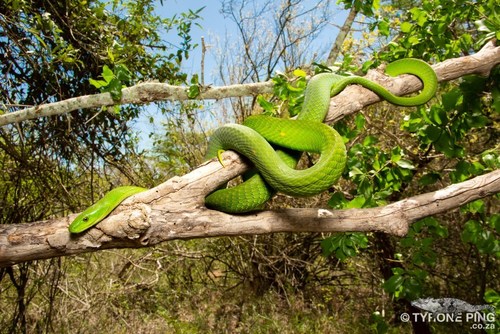
Eastern Green Mamba
Dendroaspis angusticeps
The emerald ghost of the African coast, the Eastern Green Mamba is a masterpiece of arboreal evolution. Virtually invisible among the leaves, this shy and graceful serpent is one of the most elusive captures for any backyard explorer.
Quick Identification
Size
Typically 1.5 to 2.0 metres (4.9 to 6.6 feet), with exceptional individuals reaching 2.5 metres (8.2 feet).
Colors
Brilliant emerald-green dorsal scales with a pale green or yellowish-green belly; some individuals may have occasional yellow scales.
Key Features
- Slender, elongated body with a distinct coffin-shaped head
- Large, smooth scales that provide a glossy appearance
- Relatively large eyes with round pupils and green or gold irises
- Long, tapering tail that aids in arboreal movement
When You’ll See Them
Geographic range
Where Does the Eastern Green Mamba Live?
Native to the coastal regions of East and Southern Africa, the Eastern Green Mamba thrives in a humid belt extending from Kenya down through Tanzania, Malawi, and Mozambique into the eastern provinces of South Africa. This species is a lowland specialist, rarely found far from the moist influence of the Indian Ocean, though it does follow riverine gallery forests inland into parts of Zimbabwe. It is a true resident of the African tropics, favoring stable, high-rainfall environments over the arid savannas found further west.
Basemap © OpenStreetMap contributors
Behavior
The Eastern Green Mamba is a shy and reclusive arboreal specialist, spending the vast majority of its life high within the forest canopy or thickets. Unlike its more famous relative, the Black Mamba, this species is hesitant to strike and prefers to flee into dense foliage when disturbed. It is a master of camouflage, blending perfectly with sun-dappled leaves to remain undetected by both predators and prey.
Primarily active during the day (diurnal), these snakes are solitary and rarely venture to the forest floor except to bask in a sun patch or occasionally cross between trees. While they are highly venomous with a potent neurotoxic bite, human encounters are relatively rare due to their preference for heights and their non-aggressive temperament. They are known for their extreme agility, moving through the branches with a fluid, almost weightless grace.
EverydayEarth exclusive
Camera Tips
To capture the Eastern Green Mamba on camera, you must think vertically. Conventional trail cameras mounted at knee height will likely miss this species entirely. Instead, mount your camera 2 to 4 metres high, focusing on thick horizontal branches or 'highways' in the canopy where the snake may traverse between feeding or basking sites. Use a sturdy strap and ensure the camera is angled slightly downward to capture the length of the branch.
Trigger speed is critical for mambas. These snakes move with surprising fluidity and can clear a camera's field of view in a fraction of a second. Set your camera to its fastest possible trigger mode and consider a 'Burst' or 'Multi-Shot' setting. This ensures that even if the snake is moving quickly, you capture several frames to help with positive identification. High-definition video (1080p or higher) is often better than stills for identifying the subtle scale patterns of this species.
Because they are active hunters of birds, placing cameras near active nesting sites or fruiting trees (like wild figs or mangoes) that attract birds can increase your chances of a sighting. However, avoid placing cameras too close to nests to prevent disturbing the birds. The best time for capture is mid-morning when the snakes emerge to bask in the sun to regulate their body temperature. Look for 'sun-breaks'—spots where the sunlight penetrates the canopy and hits a prominent branch.
Safety is paramount when checking your equipment. Always use a long stick to check the immediate area around the camera before reaching for it, as these snakes are perfectly camouflaged and may be resting on the very branch your camera is mounted to. If your camera allows for wireless or Bluetooth image transfer, utilize it to minimize the frequency of physical checks in dense, mamba-prone foliage.
Similar Species
Species that look similar or are commonly confused with Eastern Green Mamba.
Boomslang
The Boomslang has much larger eyes and a shorter, blunt snout compared to the mamba's elongated head.
Spotted Bush Snake
Much smaller and thinner, with black spots or bars on the front half of the body which mambas lack.
Green Water Snake
Lacks the mamba's coffin-shaped head and is typically found near water sources rather than high in the canopy.
Frequently Asked Questions
Record Eastern Green Mamba at your habitat
Connect a camera to start building your own species record — AI identifies every visitor automatically.