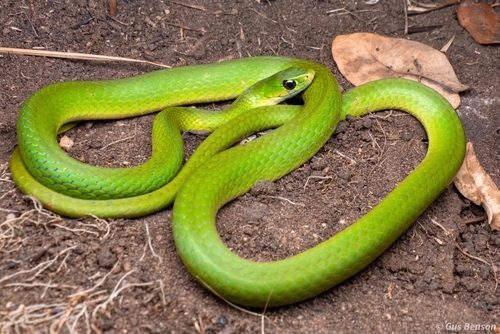
Green Water Snake
Philothamnus hoplogaster
A harmless, emerald-hued beauty of the African wetlands, the Green Water Snake is a welcome visitor to any garden pond. Graceful and shy, this non-venomous hunter is a master of camouflage and a delight for backyard wildlife observers.
Quick Identification
Size
A slender snake typically reaching 60–90 cm (24–35 inches), with rare individuals slightly exceeding 1 metre.
Colors
Uniform bright green to olive-green above; underparts are usually white, cream, or pale yellow; lacks the dark spotting found in similar green snakes.
Key Features
- Vibrant emerald green body without spots
- Large, dark eyes with round pupils
- White or pale yellow belly
- Slender build with a long, tapering tail
- Smooth scales with a satin-like texture
When You’ll See Them
Geographic range
Where Does the Green Water Snake Live?
The Green Water Snake is native to the southeastern regions of the African continent. It is most commonly found throughout the eastern half of South Africa, extending northwards through Mozambique, Zimbabwe, and Malawi. Its range continues into East Africa, where it inhabits moist savanna and coastal regions of Tanzania and Kenya.
Basemap © OpenStreetMap contributors
Behavior
The Green Water Snake is a diurnal hunter, meaning it is most active during the daylight hours. Highly agile and graceful, it is equally at home swimming through garden ponds or climbing through low-hanging shrubs and reeds. Unlike many other snakes that may strike when cornered, this species is exceptionally placid and rarely attempts to bite humans, preferring to flee into the water or thick undergrowth at the first sign of danger.
As a semi-aquatic species, it relies heavily on its camouflage. Its brilliant green scales allow it to vanish against lush garden foliage or aquatic plants. It spends much of its morning basking in the sun to regulate its body temperature before moving off to hunt for its preferred prey of amphibians and small fish.
EverydayEarth exclusive
Camera Tips
To successfully capture the Green Water Snake on a backyard camera, focus on the transition zones between land and water. Position your camera roughly 12 to 18 inches off the ground, aimed at flat rocks near the edge of a pond or gaps in thick reed beds. These snakes are cold-blooded and frequently seek out 'basking spots'—flat, sun-drenched surfaces where they can warm up in the morning. Setting your camera to face one of these sunny stones between 8 AM and 11 AM provides the highest probability of a clear, stationary shot.
Because these snakes are diurnal and move with quick, fluid motions, a camera with a fast trigger speed (under 0.5 seconds) is essential to avoid capturing just a tail as they glide past. Many standard trail cameras rely on Passive Infrared (PIR) sensors which detect heat; however, because snakes are ectothermic, they may not always trigger the sensor if their body temperature matches the environment. To combat this, use 'Time Lapse' mode if your camera supports it, setting it to take an image every 1–2 minutes during peak daylight hours.
Avoid using artificial lures or baits, as these snakes are active hunters of live prey and won't be attracted to food scraps. Instead, cultivate a snake-friendly environment by maintaining a healthy frog population and providing low-lying cover like logs or dense groundcover. If you are using a camera with adjustable sensitivity, set it to 'High' to increase the chances of the small, slender body of the snake triggering a recording.
Finally, pay attention to the lighting. The brilliant emerald hue of the Green Water Snake is its most striking feature but can be easily washed out by mid-day glare. Position your camera so the sun is behind it or at a 45-degree angle. This will help highlight the satin-like sheen of the scales and the distinct round pupil of the eye, which is a key identifying feature for this harmless species.
Similar Species
Species that look similar or are commonly confused with Green Water Snake.
Spotted Bush Snake
The Bush Snake has distinct black spots or cross-bars on the front half of its body, whereas the Green Water Snake is uniformly green.
Western Natal Green Snake
This species often has blue pigment between its scales that becomes visible when it moves, and it is more strictly arboreal than the Green Water Snake.
Boomslang
A highly venomous species with much larger eyes, keeled (ridged) scales, and a distinctively shaped head; it is also typically much larger as an adult.
Frequently Asked Questions
Record Green Water Snake at your habitat
Connect a camera to start building your own species record — AI identifies every visitor automatically.