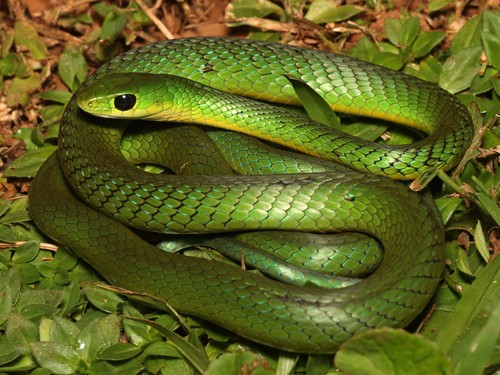
Western Natal Green Snake
Philothamnus occidentalis
A vibrant, emerald-green jewel of the garden, the Western Natal Green Snake is a harmless arboreal hunter that thrives in lush, leafy environments. Watching one glide effortlessly through the branches is one of the true highlights of African backyard wildlife watching.
Quick Identification
Size
Typically 60–90 cm (24–35 inches) in length, with exceptional specimens reaching 115 cm (45 inches).
Colors
Brilliant emerald or lime green dorsally; the belly is usually a pale greenish-yellow or off-white. Some individuals may show small black spots or turquoise edges on their scales.
Key Features
- Extremely slender, whip-like body
- Large, gold-rimmed eyes with round pupils
- Uniformly green head that is distinct from the neck
- Slightly keeled scales that give a satiny appearance
When You’ll See Them
Geographic range
Where Does the Western Natal Green Snake Live?
The Western Natal Green Snake is native to the African continent, primarily concentrated in the southern and eastern regions. Its core range spans across South Africa, particularly within the Western Cape, Eastern Cape, and KwaZulu-Natal provinces, extending northwards into parts of Zimbabwe and Mozambique. This species is a common sight in moist, low-lying coastal belts and inland forests where water and dense vegetation are abundant.
Basemap © OpenStreetMap contributors
Behavior
The Western Natal Green Snake is a highly active and agile diurnal hunter. It is predominantly arboreal, meaning it spends most of its life navigating the canopies of trees and shrubs, though it is equally comfortable moving across the ground or swimming through garden ponds. Because they are non-venomous and lack significant defensive weapons, they rely on their incredible speed and cryptic coloration to avoid detection by predators like hawks and mongooses.
In residential areas, these snakes are often found in well-watered gardens. They are nervous by nature and will quickly dash for cover if approached by a human. While they may inflate their necks or strike if they feel completely cornered, they are entirely harmless and do not possess venom glands. Their presence in a backyard is usually a sign of a healthy ecosystem with plenty of amphibian life.
EverydayEarth exclusive
Camera Tips
Capturing the Western Natal Green Snake on a trail camera requires a strategy focused on their arboreal habits. Unlike ground-dwelling snakes, these climbers often move along fence lines, trellises, or the thin outer branches of shrubs. Mount your camera at eye level (about 1.5 meters) and aim it along a known 'green corridor'—a line of connected bushes or a garden hedge—where the snake can travel without touching the ground.
Because snakes are ectothermic, their body temperature often matches the environment, which can make it difficult for standard PIR (Passive Infrared) sensors to trigger. To overcome this, use your camera's 'Time Lapse' mode during the warmest parts of the day, setting an interval of 30 to 60 seconds. This allows you to catch the snake as it basks or hunts even if it doesn't trigger the motion sensor. If your camera has a 'High Sensitivity' motion setting, be sure to enable it.
Water is the ultimate draw for this species. If you have a backyard pond or a birdbath surrounded by thick foliage, position your camera to overlook the water's edge. These snakes are frequent visitors to water sources to hunt for frogs. Using a camera with a fast trigger speed (under 0.3 seconds) is vital, as these snakes move with surprising speed when they are on the hunt or feel exposed.
For the best image quality, ensure your camera is positioned so the sun is behind it. The Western Natal Green Snake's emerald scales are highly reflective and look spectacular in direct sunlight. However, avoid placing the camera too close to leaves that might blow in the wind, as the constant movement will fill your SD card with 'false' triggers, especially when using the high-sensitivity settings needed for reptiles.
Similar Species
Species that look similar or are commonly confused with Western Natal Green Snake.
Spotted Bush Snake
The Spotted Bush Snake has distinct black spots or bars on the front half of its body, whereas the Western Natal Green Snake is usually a more uniform green.
Boomslang
The Boomslang is venomous and has much larger eyes, a deeper head, and keeled scales that give it a rougher appearance compared to the smooth Natal Green Snake.
Frequently Asked Questions
Record Western Natal Green Snake at your habitat
Connect a camera to start building your own species record — AI identifies every visitor automatically.