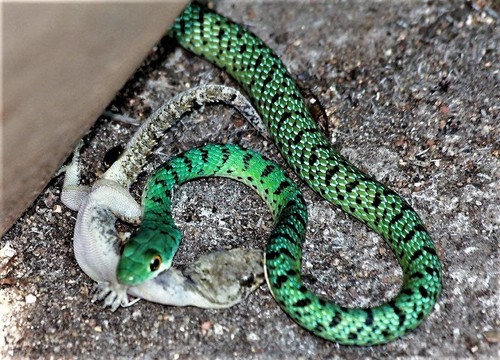
Spotted Bush Snake
Philothamnus semivariegatus
A slender, emerald-green acrobat of the garden, the Spotted Bush Snake is a harmless hunter that moves with lightning speed through the leaves.
Quick Identification
Size
Typically ranges from 60–100 cm (24–40 inches) in length, though exceptional specimens can reach 130 cm (51 inches).
Colors
Bright emerald to chartreuse green with distinct black spots or cross-bars on the front half of the body; belly is pale green or cream.
Key Features
- Bright green body with black spots or bars on the anterior half
- Large golden-yellow eyes with round pupils
- Extremely slender build with a long, tapering tail
- Keeled ventral scales adapted for expert climbing
When You’ll See Them
Geographic range
Where Does the Spotted Bush Snake Live?
The Spotted Bush Snake is native to the African continent and maintains an expansive range across Sub-Saharan Africa. It is commonly found from the southern provinces of South Africa and Namibia, moving northwards through Botswana, Zimbabwe, and Mozambique into East Africa and parts of West Africa. Its adaptability allows it to thrive in both coastal bush and inland plateaus, provided there is sufficient vegetation and moisture.
Basemap © OpenStreetMap contributors
Behavior
The Spotted Bush Snake is a diurnal and highly active reptile known for its incredible speed and agility. As a master of the vertical world, it spends much of its time navigating trees, shrubs, and even the brick walls of houses in search of prey. It is a non-venomous species and is entirely harmless to humans, typically choosing to flee at high speed into the nearest thicket rather than confront a perceived threat.
Because of their slender bodies and vibrant coloration, they are often mistaken for the venomous Boomslang or Green Mamba, but their behavior is far more frantic and their body much thinner. In a backyard setting, they are excellent neighbors as they provide natural pest control, keeping populations of geckos and house-dwelling frogs in balance. They are solitary creatures that use their keen eyesight to hunt by sight during the warmest parts of the day.
EverydayEarth exclusive
Camera Tips
To capture the Spotted Bush Snake on your backyard camera, you need to think vertically. Unlike many snakes that crawl along the ground, this species is frequently found on garden fences, trellises, or navigating the top of a hedge. Mount your camera about 3 to 5 feet off the ground, angled toward a known travel route like a wooden railing or a leafy branch that bridges two trees.
Because these snakes are exceptionally fast, trigger speed is critical. Set your AI-powered camera to its highest sensitivity and fastest capture mode to ensure you don't just catch a glimpse of a disappearing tail. High-resolution video is often better than stills for this species, as their green-and-black pattern provides excellent camouflage against leaves; the movement in a video clip makes them much easier to identify.
While you cannot easily bait these snakes, you can attract them by creating a 'micro-habitat' for their favorite snacks. A small garden pond or a cluster of potted plants that attracts tree frogs and geckos will naturally bring Spotted Bush Snakes into the frame. Position your camera near these hunting grounds during the mid-morning when the sun is out, as they are most active when the ambient temperature is warm enough to fuel their high-speed hunts.
Similar Species
Species that look similar or are commonly confused with Spotted Bush Snake.
Boomslang
The Boomslang is much thicker, has a blunt head, and a much larger eye; it is highly venomous while the Spotted Bush Snake is harmless.
Western Natal Green Snake
This species lacks the black spots on the front half of the body and typically has a more uniform green or yellowish-green appearance.
Frequently Asked Questions
Record Spotted Bush Snake at your habitat
Connect a camera to start building your own species record — AI identifies every visitor automatically.