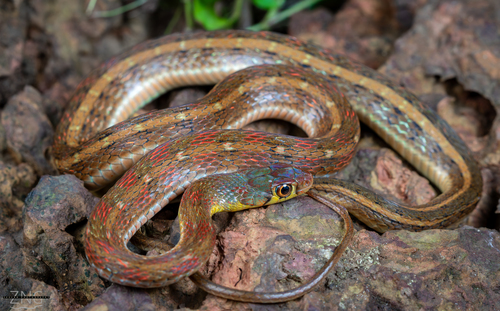
Buff Striped Keelback
Amphiesma stolatum
A gentle gardener's companion, the Buff Striped Keelback is a master of disguise with its striking yellow racing stripes. This nonvenomous reptile is the Asian equivalent of the garter snake and a fascinating find for any backyard observer.
Quick Identification
Size
40–80 cm (16–31 in) in length; slender build typically weighing under 250g (8.8 oz)
Colors
Olive-brown or greyish-brown body with two prominent buff or yellow stripes running down the back; blackish crossbars between the stripes; cream-colored underbelly
Key Features
- Two distinct longitudinal buff-yellow stripes
- Keels on dorsal scales giving a rough texture
- Cream or yellow upper lip (labials) with thin black borders
- Large eyes with round pupils
When You’ll See Them
Geographic range
Where Does the Buff Striped Keelback Live?
This species is natively widely distributed across South and Southeast Asia. Its core range spans from the river valleys of Pakistan and the lush plains of India and Sri Lanka to the highlands of Nepal and Bhutan. It also flourishes further east throughout Myanmar, Thailand, Vietnam, and Southern China, where it is frequently found in agricultural landscapes and residential gardens near human settlements.
Basemap © OpenStreetMap contributors
Behavior
The Buff Striped Keelback is one of the most docile and non-aggressive snakes you might encounter in your backyard. Unlike many of its relatives, it rarely strikes or bites even when handled, preferring to remain motionless or attempt a quiet escape into the undergrowth. This gentle nature makes it a favorite among wildlife observers in Asia, where it is often tolerated or even welcomed in gardens as a natural form of pest control.
These snakes are primarily diurnal, meaning they are active during the day. You will often find them sunning themselves in the early morning to regulate their body temperature before they begin their hunt. They are solitary creatures that do not form social groups, though you may find several in a small area if the local frog population is particularly high. During the cooler winter months in northern parts of their range, they may undergo a period of brumation (hibernation) in rock crevices or hollow logs.
EverydayEarth exclusive
Camera Tips
To capture the Buff Striped Keelback on a trail camera, placement is everything. Since these snakes are ground-dwellers and relatively small, you must position your camera just a few inches off the ground. Aiming the camera along a 'drift fence' (like a fallen log or a garden edge) can help funnel the snake into the frame. Angle the camera slightly downward to ensure the sensor triggers on their low-profile movement.
Focus your efforts on transition zones—places where a manicured lawn meets taller grass or a garden pond. Because their primary diet consists of amphibians, placing a camera near a water feature or a damp, shaded area of your yard during the morning hours will significantly increase your chances of a sighting. They are particularly active after a fresh rain when frogs are most mobile.
Since snakes move with a different heat signature and speed than mammals, use a camera with a high-speed trigger and consider 'Burst Mode.' This ensures that even if the snake is moving quickly across the frame, you get at least one clear shot of those identifying yellow stripes. Avoid using heavy baits; instead, maintain a healthy, chemical-free garden that attracts the frogs and toads they naturally hunt.
Similar Species
Species that look similar or are commonly confused with Buff Striped Keelback.
Frequently Asked Questions
Record Buff Striped Keelback at your habitat
Connect a camera to start building your own species record — AI identifies every visitor automatically.