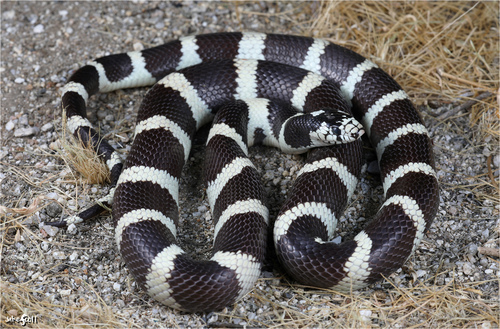
California King Snake
Lampropeltis californiae
Elegant, powerful, and remarkably bold, the California King Snake is the 'royalty' of western reptiles. Famous for its striking black-and-white patterns and its ability to hunt rattlesnakes, this non-venomous neighbor is a fascinating sight for any backyard nature enthusiast.
Quick Identification
Size
30 to 48 inches (76 to 122 cm) in length; rarely up to 5 feet (152 cm). Weight typically ranges from 1 to 3 lbs (450 to 1360 g).
Colors
Highly variable, most commonly featuring high-contrast alternating bands of black or chocolate brown and white or cream. Some individuals display a single longitudinal stripe down the back.
Key Features
- Bold alternating light and dark bands or stripes
- Smooth, glossy dorsal scales
- Small, rounded head only slightly wider than the neck
- Round pupils
When You’ll See Them
Geographic range
Where Does the California King Snake Live?
Native to the North American continent, the California King Snake is a quintessential western species. It is primarily found across the western United States, with a core range that stretches from southwestern Oregon through California and into the arid regions of Nevada, Utah, and Arizona. Their presence also extends southward into the Baja California peninsula and parts of northwestern Mexico. While they are a staple of the American West, they have also been introduced to the Canary Islands, where they are currently considered an invasive species.
Basemap © OpenStreetMap contributors
Behavior
California King Snakes are primarily solitary, terrestrial hunters, though they are surprisingly adept at climbing trees and swimming. They are best known for being "ophiophagous," which means they eat other snakes. This includes venomous species like rattlesnakes, as King Snakes have evolved a specialized immunity to local pit viper venom and use immense constriction pressure to overpower their prey.
While they are formidable predators in the reptile world, they are generally docile toward humans and will usually attempt to flee when encountered. If cornered, they may hiss, strike with a closed mouth, or vibrate their tails rapidly—a behavior called "rattling" that mimics a rattlesnake to ward off threats. In suburban environments, they are beneficial residents that help control rodent and venomous snake populations.
EverydayEarth exclusive
Camera Tips
Capturing a California King Snake on camera requires a specialized approach because they are ectothermic. Standard PIR (Passive Infrared) sensors on trail cameras trigger based on heat differentials; since a snake's body temperature often matches the ground, it may not trigger the sensor reliably. To fix this, set your camera to "Time Lapse" mode during the morning and evening. A 30-second or 1-minute interval is usually sufficient to catch a slow-moving snake passing through the frame.
For the best perspective, mount your camera extremely low to the ground—no more than 6 to 12 inches high—and angle it slightly downward. Position the camera along "travel corridors" such as the edges of garden fences, stone walls, or the border where a lawn meets thick brush. Snakes prefer to travel along edges where they feel protected on at least one side. You can increase your success rate by using a "drift fence," which is a simple temporary barrier like a long board or mesh that funnels the snake directly in front of the lens.
You can also attract them to a specific spot by creating a "basking station." Place a large, flat rock or a piece of corrugated metal in a sunny spot near cover. Snakes use these items to regulate their body temperature. Aim your camera at the edge of this cover. In hot summer months, shift your focus to water sources or damp areas, as King Snakes will be more active at night and drawn to moisture.
Similar Species
Species that look similar or are commonly confused with California King Snake.
Frequently Asked Questions
Record California King Snake at your habitat
Connect a camera to start building your own species record — AI identifies every visitor automatically.