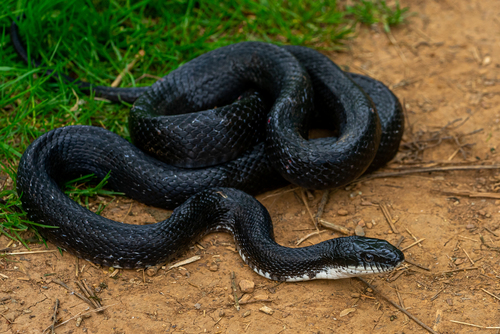
Central Ratsnake
Pantherophis alleghaniensis
The Central Ratsnake is the king of the backyard climbers, a glossy black acrobat that keeps rodent populations in check. Whether they are scaling a vertical tree trunk or basking on a garden wall, these gentle giants are a fascinating addition to any wildlife camera's highlights.
Quick Identification
Size
Adults typically range from 107 to 183 cm (3.5 to 6 feet) in length, though exceptional individuals can reach over 244 cm (8 feet). They are heavy-bodied with a weight of 0.5 to 2.2 kg (1.1 to 4.9 lbs).
Colors
Adults are primarily glossy black with white or cream-colored chins and throats. Juveniles are light gray with distinct dark brown or black blotches down the back.
Key Features
- Glossy black scales with white pigment visible between them when stretched
- White or pale yellow chin and throat
- Keeled (ridged) scales that feel slightly rough
- Loaf-of-bread shaped body profile rather than perfectly round
When You’ll See Them
Geographic range
Where Does the Central Ratsnake Live?
Native to the North American continent, the Central Ratsnake occupies a massive range across the eastern and central United States. They are commonly found from the Great Lakes region in the north, stretching down through the Mississippi River Valley to the Gulf Coast, and eastward toward the Appalachian Mountains. While they are a staple of the American Midwest and South, their range also extends into parts of southern Ontario, Canada, where they are protected as a species at risk.
Basemap © OpenStreetMap contributors
Behavior
Central Ratsnakes are incredibly agile climbers, often spending as much time in trees as they do on the ground. They are famous for their ability to scale vertical bark and navigate thin branches in search of bird nests or squirrel dens. While they are nonvenomous and generally shy, they may 'rattle' their tails in dry leaves to mimic a rattlesnake or release a foul-smelling musk if they feel cornered by a predator or a curious human.
As powerful constrictors, they play a vital role in local ecosystems by controlling rodent populations. In suburban environments, they are frequently encountered in barns, attics, or crawlspaces where mice are present. They are primarily solitary and spend the winter months brumating (the reptilian version of hibernation) in underground dens, often sharing space with other snake species to conserve heat.
EverydayEarth exclusive
Camera Tips
Capturing a Central Ratsnake on camera requires a different strategy than mammals because they are ectothermic. Standard PIR (Passive Infrared) sensors detect heat signatures, and because snakes often match the ambient temperature, they might not trigger the camera. To solve this, set your camera to 'High Sensitivity' or, better yet, use a Time-Lapse mode set to take an image every 30-60 seconds during the morning hours when they are most likely to be basking or hunting.
Placement is everything for these climbers. Instead of just pointing your camera at the ground, try mounting one 3-4 feet up a tree trunk known to have bird activity, or along a horizontal fence rail. These snakes love 'edges'—the transition zones between a lawn and a forest, or the base of a stone wall. Aiming the camera along the length of a fallen log is another high-probability setup, as snakes use these as natural highways and hunting grounds.
Don't bother with commercial lures or baits; snakes hunt by scent and movement and won't be attracted to standard mammal baits. Instead, look for 'hotspots' like bird feeders or woodpiles. A camera positioned near a woodpile in early May or June is likely to catch them as they emerge from brumation or seek out nesting females. If you are using a backyard camera, ensure it is positioned low to the ground (4-6 inches) with a wide-angle view to capture their long bodies as they pass by.
Similar Species
Species that look similar or are commonly confused with Central Ratsnake.
Frequently Asked Questions
Record Central Ratsnake at your habitat
Connect a camera to start building your own species record — AI identifies every visitor automatically.