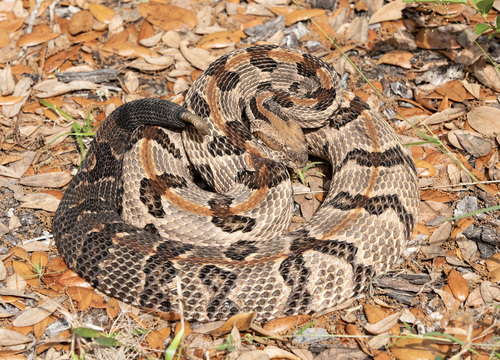
Timber Rattlesnake
Crotalus horridus
A master of camouflage and a symbol of the American wilderness, the Timber Rattlesnake is a patient forest guardian. Though often feared, this docile pit viper is a vital predator that maintains the balance of eastern ecosystems.
Quick Identification
Size
Adults typically measure 36–60 inches (91–152 cm) in length and weigh between 1.1 and 3.3 pounds (0.5–1.5 kg).
Colors
Varied base colors of sulfur yellow, gray, or tan with dark brown to black V-shaped crossbands or chevrons; tail is solid velvet-black.
Key Features
- Distinctive segmented rattle at the tail tip
- Large, triangular head with heat-sensing pits between the eye and nostril
- Dark chevron-shaped bands across the back
- Velvet-black tail just before the rattle
- Vertical, cat-like pupils
When You’ll See Them
Geographic range
Where Does the Timber Rattlesnake Live?
Native to the North American continent, the Timber Rattlesnake occupies a broad range across the eastern and central United States. Its territory extends from the rugged hills of southern New England down through the Appalachian Mountains to northern Florida, stretching as far west as eastern Texas and the Great Plains of Nebraska. While they were historically found in parts of southern Canada, they are now considered largely extirpated there, making the U.S. the primary stronghold for this majestic forest dweller.
Basemap © OpenStreetMap contributors
Behavior
Timber Rattlesnakes are quintessential ambush predators, often spending days coiled in a tight spiral near fallen logs or game trails. They are remarkably patient, relying on their sophisticated heat-sensing pits to detect the infrared signatures of passing prey. Despite their formidable reputation, they are generally shy and reclusive animals that prefer to remain undetected. Their first line of defense is their incredible camouflage, followed by a hasty retreat or the famous rattling of their tail as a final warning to stay away.
These snakes are known for their high site fidelity, often returning to the exact same sunning rocks and overwintering dens, or hibernacula, for decades. In the winter, they congregate in deep rocky crevices below the frost line, sometimes sharing these spaces with other snake species. During the summer, males and non-gravid females may wander several miles from their dens to forage, while pregnant females stay closer to rocky 'basking' sites to maintain the high body temperatures needed for embryo development.
EverydayEarth exclusive
Camera Tips
To capture high-quality footage of a Timber Rattlesnake, focus your camera placement on 'linear features' in the landscape. These snakes frequently use large fallen logs as highways and hunting blinds. Position your camera about 12 to 18 inches off the ground, aimed at a 45-degree angle toward the side of a log where a snake might be coiled or traveling. Because snakes are cold-blooded, they may not always trigger standard PIR motion sensors; using a camera with high sensitivity or a dedicated 'time-lapse' mode that fires every 30 to 60 seconds is often the most effective way to ensure you don't miss a passing viper.
Sun-drenched rocky outcroppings are another prime location, especially in the early spring (April to May) and late fall (September to October). These are basking sites where snakes gather to regulate their body temperature. During the heat of mid-summer, the snakes often become more active at night to avoid the sun, so ensure your camera has a high-quality 'no-glow' infrared flash. This prevents the snake from being startled by a visible light, allowing you to capture natural nocturnal behaviors like tongue-flicking and hunting.
Safety must be your absolute priority when setting cameras in rattlesnake habitat. Never place your hands or feet where you cannot see, such as under logs or inside rock crevices. Use a long stick to clear debris around your camera mounting point, and consider wearing snake-proof gaiters when venturing into known habitats. For the best visual results, set your camera to 'Hybrid Mode'—capturing a high-resolution still image followed by a 10-15 second video clip. This allows you to see the snake's subtle movements and listen for the rattle, providing a much richer look at their behavior than a photo alone.
Similar Species
Species that look similar or are commonly confused with Timber Rattlesnake.
Copperhead
Copperheads lack a rattle, have 'Hershey's Kiss' shaped markings, and have a copper-colored head without the black tail section.
Eastern Diamondback Rattlesnake
The Diamondback has distinct light-centered diamond patterns rather than the Timber's chevrons, and prefers coastal pine flatwoods.
Frequently Asked Questions
Record Timber Rattlesnake at your habitat
Connect a camera to start building your own species record — AI identifies every visitor automatically.