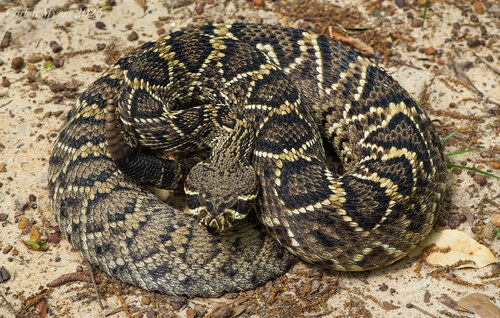
Eastern Diamondback Rattlesnake
Crotalus adamanteus
Meet the heavyweight of the Southeastern wilderness. The Eastern Diamondback Rattlesnake is an iconic master of camouflage, sporting a stunning geometric pattern that allows it to vanish into the pine forest floor.
Quick Identification
Size
3.5–5.5 ft (1.1–1.7 m) on average, reaching up to 8 ft (2.4 m); weight typically 5–15 lbs (2.3–6.8 kg).
Colors
Brown, tan, or olive-gray base with dark brown to black diamond markings outlined in cream or yellow; yellowish-white belly.
Key Features
- Large, heavy triangular head with dark eye-stripe
- Distinctive segmented rattle at the tail tip
- Diamond-shaped dorsal pattern with pale borders
- Heat-sensing pits between eyes and nostrils
When You’ll See Them
Geographic range
Where Does the Eastern Diamondback Rattlesnake Live?
The Eastern Diamondback Rattlesnake is a signature resident of the North American continent, specifically endemic to the Southeastern United States. Its core range stretches from the coastal plains of North Carolina southward through the entirety of the Florida peninsula, including the Florida Keys, and extends westward across the Gulf Coast through Alabama and Mississippi into eastern Louisiana. It is a lowland specialist, rarely straying far from the sandy soils and pine-dominated ecosystems of the Atlantic and Gulf Coastal Plains.
Basemap © OpenStreetMap contributors
Behavior
The Eastern Diamondback Rattlesnake is a reclusive and misunderstood predator. Despite its fearsome reputation, it is a shy creature that typically avoids human contact, relying on its incredible camouflage to remain undetected among leaf litter and palmetto fronds. When it does feel threatened, it utilizes its famous rattle as a defensive warning, though it may strike if cornered or stepped upon. They are primarily terrestrial but are surprisingly capable swimmers and can occasionally be found climbing low-lying vegetation.
As an ambush predator, this snake spends long periods coiled in a strike position, waiting for prey to pass within range. They are solitary animals, though they may share gopher tortoise burrows during the colder winter months for thermoregulation. In terms of human interaction, they are vital for controlling rodent populations but should always be viewed from a respectful distance; they do not chase humans and prefer to retreat if given the opportunity.
EverydayEarth exclusive
Camera Tips
To capture high-quality footage of an Eastern Diamondback, placement is everything. These snakes are strictly ground-dwellers, so your camera must be mounted extremely low—no more than 6 to 12 inches off the ground. Aim the lens parallel to the floor of the forest or trail. Look for 'natural highways' such as the edges of fallen logs, gaps in palmetto thickets, or the entrances to gopher tortoise burrows, which are favorite hiding spots. Because they are ectothermic, they don't always trigger standard PIR sensors as effectively as mammals; setting your camera to 'Time Lapse' mode with short intervals or using a high-sensitivity trigger setting is recommended.
Timing is crucial for successful captures. In the heat of mid-summer, these snakes are almost exclusively crepuscular or nocturnal to avoid the midday sun. Set your camera to be most active during the golden hours of dawn and dusk. During the spring and fall, you are more likely to catch them basking in sunny patches or moving between habitats during the day. Avoid using artificial lures or baits, as these snakes respond to live movement and scent trails of rodents; instead, place your camera near areas with high rodent activity to increase your chances.
Safety should be your primary concern when checking your equipment. Always wear snake-proof boots or gaiters and use a long stick or reaching tool to clear vegetation around your camera before touching it. Eastern Diamondbacks are masters of blending in, and a coiled snake can easily look like a pile of leaves. Use a wide-angle lens setting if available to capture the snake's full body and its characteristic 'S-coil' ambush posture, which provides fascinating insight into their hunting behavior without needing to get dangerously close.
Similar Species
Species that look similar or are commonly confused with Eastern Diamondback Rattlesnake.
Frequently Asked Questions
Record Eastern Diamondback Rattlesnake at your habitat
Connect a camera to start building your own species record — AI identifies every visitor automatically.