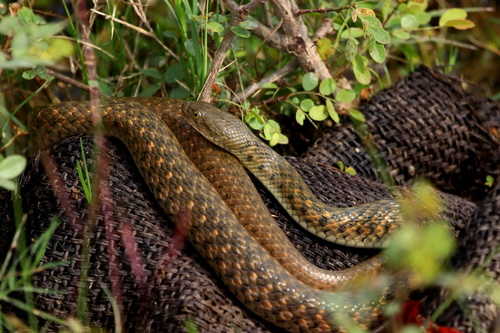
Chequered Keelback
Fowlea piscator
A striking, semiaquatic hunter, the Chequered Keelback is the king of the rice paddies and garden ponds across Asia. Recognized by its bold checkerboard pattern and feisty personality, this non-venomous snake is a master of the water.
Quick Identification
Size
60–120 cm (24–47 inches) in length, occasionally reaching 175 cm (69 inches); weight varies by size but is typically light and slender.
Colors
Olive-green, grey, or brownish-yellow upper body with black spots arranged in a checkerboard pattern; two distinct black streaks behind the eyes; white or cream-colored belly.
Key Features
- Distinctive checkerboard pattern of black spots
- Two black diagonal streaks behind each eye
- Strongly keeled scales that feel rough to the touch
- Round pupils and large eyes for hunting
When You’ll See Them
Geographic range
Where Does the Chequered Keelback Live?
Native to the vast wetlands and river basins of Asia, the Chequered Keelback is one of the most widely distributed snakes in the region. Its core range spans from Pakistan and India in the west, through the Himalayan foothills of Nepal and Bhutan, and across Southeast Asian nations like Thailand, Vietnam, and Malaysia. It is also commonly found throughout southern China and the islands of Indonesia, thriving anywhere that provides a consistent source of freshwater.
Basemap © OpenStreetMap contributors
Behavior
The Chequered Keelback is a highly active and semiaquatic snake known for its incredible agility both in water and on land. It is primarily diurnal, though it often shifts to nocturnal activity during the peak of summer to avoid the heat. While it is non-venomous, this species is famous among herpetologists for its feisty temperament; if cornered, it will flatten its head, hiss loudly, and strike repeatedly with speed. Despite this bravado, its first instinct is almost always to dive into the nearest water source and swim away.
As an excellent hunter, it is often seen with its head bobbing above the water's surface as it scans for prey. They are solitary creatures, though many individuals may congregate in shrinking pools during the dry season to capitalize on trapped fish. In suburban areas, they are frequently found in garden ponds or drainage ditches, where they play a vital role in controlling frog and rodent populations.
EverydayEarth exclusive
Camera Tips
To capture the Chequered Keelback on camera, position your device as close to the water's edge as possible. These snakes are most active along the 'riparian zone'—the transition area between land and water. Placing the camera 4-6 inches off the ground at a slight downward angle toward a muddy bank or a flat rock where they might bask will yield the best results. Look for areas with lily pads or floating vegetation, as they often rest there with just their heads visible.
Because snakes are ectothermic (cold-blooded), standard Passive Infrared (PIR) sensors on trail cameras can sometimes fail to trigger because the snake's body temperature matches the environment. To combat this, set your camera to its highest sensitivity level. If your camera supports a 'Time-Lapse' mode, set it to take a photo every 30-60 seconds during the morning hours (7:00 AM to 10:00 AM) when they are most likely to be out basking or hunting.
Video mode is highly recommended for this species. Their swimming motion is beautiful to witness, and a still photo may miss the subtle ripple they create. In a backyard setting, a small garden pond is the ultimate 'bait.' You don't need to provide food; if you have frogs or small fish in your pond, the keelback will eventually find them. Ensure your camera is well-camouflaged and waterproof, as these snakes are wary of large, moving objects but will ignore a stationary camera after a few minutes.
Similar Species
Species that look similar or are commonly confused with Chequered Keelback.
Buff-striped Keelback
The Buff-striped Keelback has two distinct yellow or cream longitudinal stripes running down its back, whereas the Chequered Keelback has a spotted, checkerboard pattern.
Olive Keelback
The Olive Keelback is typically more uniform in color with less distinct spotting and is much more aquatic, rarely leaving the water.
Frequently Asked Questions
Record Chequered Keelback at your habitat
Connect a camera to start building your own species record — AI identifies every visitor automatically.