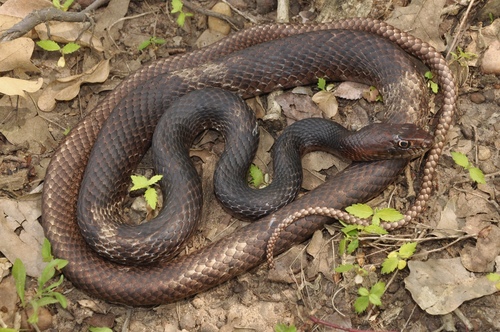
Common Coachwhip
Masticophis flagellum
Meet the speed demon of the American brush. Slender, lightning-fast, and possessing a gaze as keen as a hawk's, the Common Coachwhip is a master of the open landscape.
Quick Identification
Size
36 to 102 inches (91 to 259 cm); weight typically 1 to 4 lbs (0.5 to 1.8 kg)
Colors
Varied by subspecies: Easterns are dark brown or black fading to a tan tail; Westerns (Red Racers) are reddish-pink with dark crossbands; Sonoran variants have distinct banding.
Key Features
- Distinctive braided scale pattern on the tail resembling a leather whip
- Large eyes with round pupils and a keen, alert expression
- Slender, whip-like body that tapers significantly toward the tail
- Extremely fast movement, reaching speeds of up to 4 miles per hour
When You’ll See Them
Geographic range
Where Does the Common Coachwhip Live?
Native to the North American continent, the Common Coachwhip maintains a massive footprint across the southern half of the United States and northern Mexico. Its range stretches from the Atlantic coast of North Carolina down through Florida, across the Great Plains to the Pacific coast of California, reaching as far south as the Mexican states of Querétaro and Colima. These snakes are highly adaptable to arid environments, making them a common sight in the Mojave, Chihuahuan, and Sonoran deserts where few other predators hunt in the midday sun.
Basemap © OpenStreetMap contributors
Behavior
Common Coachwhips are among the most active and inquisitive snakes in North America. Unlike many reptiles that hide during the heat of the day, coachwhips are strictly diurnal and thrive in high temperatures that would drive other species underground. They are famous for their 'periscoping' behavior, where they lift the front third of their body high off the ground to scan the horizon for prey or potential threats using their excellent eyesight.
When confronted, coachwhips are high-strung and nervous. Their first instinct is to flee at remarkable speeds, often disappearing into rodent burrows or thick brush before a human can react. If cornered, however, they are known for their defensive aggression, striking repeatedly and vibrating their tails to deter predators. Despite this feisty reputation, they are entirely non-venomous and serve as vital pest controllers in their ecosystems.
EverydayEarth exclusive
Camera Tips
To capture the Common Coachwhip on camera, placement is everything. Because these snakes are incredibly fast and hunt using sight, they frequently travel along 'corridors' such as fence lines, garden edges, or the transition zone between tall grass and open dirt. Set your AI-powered camera at ground level, angled slightly upward or parallel to the ground. Using a wide-angle lens setting is beneficial because these snakes can exceed six feet in length; a tight frame might only capture a blur of scales as they zip past at full tilt.
Since coachwhips are most active during the hottest parts of the day when other animals are seeking shade, ensure your camera's shutter speed or 'motion freeze' settings are optimized for high-speed movement and bright light. They don't respond well to traditional baits, but you can increase your chances of a sighting by placing your camera near 'lizard hotspots'—sun-drenched rock piles, stone walls, or fallen logs where their favorite prey congregates. A small water feature or birdbath in an arid backyard can also be a significant draw during mid-summer droughts.
Seasonally, the best time for recording is during the spring breeding season (April to June) when males are actively searching for mates and are less cautious. Because they are strictly diurnal, you can save battery and storage space by scheduling your camera to only trigger during daylight hours. Look for the distinctive 'periscoping' behavior on your footage; when the snake stops to lift its head high, it provides the perfect opportunity for a clear, high-resolution identification shot that captures their unique facial features and large eyes.
Similar Species
Species that look similar or are commonly confused with Common Coachwhip.
Frequently Asked Questions
Record Common Coachwhip at your habitat
Connect a camera to start building your own species record — AI identifies every visitor automatically.