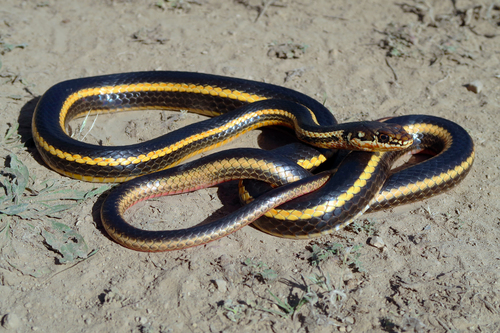
Striped Racer
Masticophis lateralis
A master of speed and agility, the Striped Racer is a sleek, striped hunter that brings a touch of wild California to suburban hillsides. Watch for its distinctive 'periscoping' head as it navigates the chaparral with lightning precision.
Quick Identification
Size
30-60 inches (76-152 cm) in length; very slender build
Colors
Dark brown, slate, or black dorsal color with two distinct, unbroken pale yellow or cream-colored stripes running down the sides; belly is cream to pale yellow, often with a pinkish hue near the tail
Key Features
- Two prominent yellow lateral stripes on a dark background
- Exceptionally slender body and long, whip-like tail
- Large eyes with round pupils and keen vision
- Often 'periscopes' by lifting its head high above the ground
When You’ll See Them
Geographic range
Where Does the Striped Racer Live?
The Striped Racer is a signature species of the North American West, found almost exclusively within the state of California and the Baja California peninsula of Mexico. Its core range extends from the northern California Coast Ranges and the Sierra Nevada foothills down through the Transverse Ranges into the arid scrublands of northern Mexico. While it is a true Californian specialist, it is highly adaptable to the various microclimates found within the Mediterranean-style ecosystems of the Pacific coast.
Basemap © OpenStreetMap contributors
Behavior
The Striped Racer is one of the most agile and alert reptiles you will encounter in the wild. Unlike many snakes that rely on camouflage or ambush tactics, the racer is an active, diurnal hunter. It uses its incredible speed and sharp eyesight to track and chase down prey during the heat of the day. It is famous for its 'periscoping' behavior, where it lifts the front third of its body off the ground to peer over tall grass or rocks to scan for predators or movement.
These snakes are generally very shy around humans and will vanish into the brush at the slightest vibration or sudden shadow. If cornered, they are high-strung and defensive, striking quickly to defend themselves, though they are non-venomous and pose no danger to people or pets. They are solitary creatures, typically only coming together during the spring mating season before returning to their expansive home ranges.
EverydayEarth exclusive
Camera Tips
Capturing a Striped Racer on a backyard camera requires a strategy focused on 'basking sites' and 'travel corridors.' Because these snakes are diurnal and cold-blooded, they seek out flat rocks, garden retaining walls, or patches of bare earth that catch the morning sun. Position your camera 6-12 inches off the ground, angled to look across the surface of a rock or along the base of a fence line where the snake is likely to travel while hunting.
Speed is the biggest challenge when filming this species. Striped Racers aren't called 'racers' for nothing—they can move several feet in a second. To avoid getting a video of a disappearing tail, set your camera to its highest possible frame rate (60fps is ideal) and use a 'Burst Mode' for stills. A camera with a fast trigger speed (0.2 seconds or less) is essential. If your camera supports it, use a wide-angle lens setting to give the snake more time to stay within the frame.
While you can't easily bait a racer with food, you can attract them by creating a lizard-friendly environment. Rock piles, native shrubs, and a low-profile water saucer will attract the lizards that racers hunt. Placing your camera near a shallow water source on a hot day is one of the most effective ways to get a high-quality, stationary shot of the snake as it pauses to drink. Avoid high-traffic human areas, as these snakes are extremely sensitive to the vibrations of footsteps and will hide long before you see them.
Similar Species
Species that look similar or are commonly confused with Striped Racer.
Western Terrestrial Garter Snake
Features a central dorsal stripe in addition to side stripes; much slower and thicker-bodied than the racer.
North American Racer
Uniformly dark or olive-colored without the two prominent yellow lateral stripes found on the Striped Racer.
Western Patch-nosed Snake
Also has lateral stripes but features a unique, enlarged scale over the tip of its snout.
Frequently Asked Questions
Record Striped Racer at your habitat
Connect a camera to start building your own species record — AI identifies every visitor automatically.