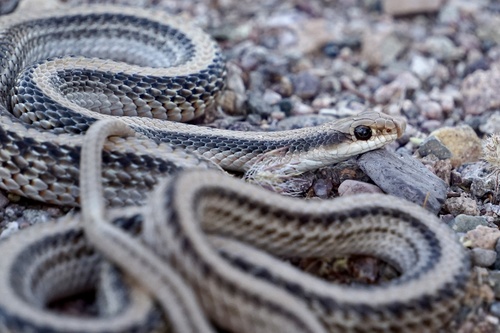
Western Patch-nosed Snake
Salvadora hexalepis
Meet the desert’s most specialized excavator. The Western Patch-nosed Snake is a sleek, striped speedster known for the unique 'patch' on its nose used to unearth hidden meals in the sun-drenched Southwest.
Quick Identification
Size
20 to 46 inches (51 to 117 cm) in total length
Colors
Pale gray or tan background with two dark longitudinal stripes; white or cream-colored belly, sometimes with a pinkish tint toward the tail.
Key Features
- Large triangular scale on the tip of the snout
- Two dark brown or black stripes running the length of the body
- Slender build with a long, tapering tail
- Large eyes with round pupils
When You’ll See Them
Geographic range
Where Does the Western Patch-nosed Snake Live?
Native to North America, the Western Patch-nosed Snake thrives across the arid Southwestern United States and northern Mexico. Its core range spans from coastal California through the Mojave and Sonoran Deserts of Arizona and Nevada, reaching south into the Baja California peninsula and parts of Sonora.
Basemap © OpenStreetMap contributors
Behavior
The Western Patch-nosed Snake is a high-speed specialist of the desert. Unlike many heavy-bodied snakes, this species relies on its incredible agility to evade predators and hunt active prey. They are strictly diurnal, meaning you’ll only spot them during the daylight hours, often darting between bushes or rocky crevices with surprising speed.
While they are generally shy and will flee at the first sign of a human, they are curious foragers. They use their unique snout to probe through loose soil and leaf litter for buried lizard eggs. When cornered, they may hiss or vibrate their tails to mimic a rattlesnake, but they are non-venomous and entirely harmless to humans and pets.
EverydayEarth exclusive
Camera Tips
To capture this fast-moving reptile, place your camera near natural 'travel lanes' like the edges of large boulders or along the base of desert shrubs. Because they are low to the ground and move quickly, set your camera just 6 to 12 inches off the ground. A downward angle (around 20 degrees) helps ensure you capture the top of the head, which is where that distinctive patch-nose scale is most visible.
Western Patch-nosed Snakes are highly active foragers. You can encourage them to linger in front of your lens by creating a 'micro-habitat' using a flat rock or a piece of driftwood near a patch of loose soil. They often investigate these areas for lizard eggs or sleeping lizards. Avoid using food bait; instead, focus on areas with high lizard activity, as the snake will naturally follow the scent of its prey.
Given their speed, camera settings are crucial. Use a 'Fast' or 'Instant' trigger speed setting if your device allows it. A high-frame-rate video mode (60fps) is better than still photos for this species, as it allows you to see their fluid movement and characteristic tongue-flicking behavior. During the peak of summer, they may become most active in the early morning and late afternoon to avoid the blistering midday sun, so ensure your camera is positioned to avoid direct lens flare during these golden hours.
Similar Species
Species that look similar or are commonly confused with Western Patch-nosed Snake.
Frequently Asked Questions
Record Western Patch-nosed Snake at your habitat
Connect a camera to start building your own species record — AI identifies every visitor automatically.