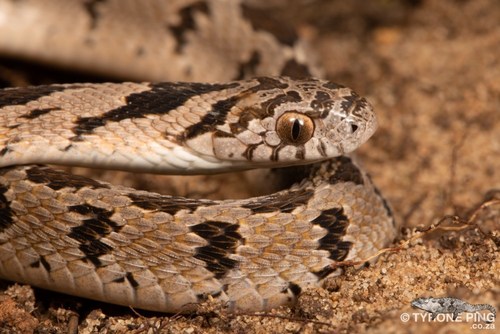
Egg-eating Snake
Dasypeltis scabra
A toothless wonder of the reptile world, the Egg-eating Snake is a master of mimicry that lives on a diet of liquid gold. Harmless to humans, this nocturnal specialist is a fascinating visitor to gardens across Africa.
Quick Identification
Size
Typically 45–75 cm (18–30 inches), though large females can reach 120 cm (47 inches).
Colors
Grey, light brown, or olive-tan with a series of dark, square or diamond-shaped (rhombic) blotches along the spine; belly is usually cream or white.
Key Features
- Distinctive dark rhombic markings along the back
- V-shaped 'chevron' markings on the head and neck
- Rough, strongly keeled scales
- Small head with a rounded snout and toothless appearance
When You’ll See Them
Geographic range
Where Does the Egg-eating Snake Live?
Native to the African continent, the Egg-eating Snake is widely distributed across Sub-Saharan Africa. Its range extends from the southern tip of South Africa and Namibia, northward through East Africa into Ethiopia and Sudan. It is also found in isolated populations across the Arabian Peninsula, specifically in Yemen and parts of Saudi Arabia. It is one of the most common snakes in many parts of its range due to its ability to thrive in modified human environments.
Basemap © OpenStreetMap contributors
Behavior
The Egg-eating Snake is a remarkable specialist that has evolved to survive exclusively on bird eggs. Because it lacks functional teeth, it is completely harmless to humans and cannot bite in the traditional sense. When it finds an egg, it uses its highly flexible jaws to swallow it whole. Specialized bony projections on the inside of its neck vertebrae then crack the shell, allowing the snake to swallow the liquid contents and regurgitate the crushed shell in a neat, dry pellet.
This species is a master of bluffing. When it feels threatened, it performs an elaborate defensive display: it coils its body and rubs its rough, keeled scales together, creating a loud, rasping hiss that mimics the sound of a venomous viper. It will also strike with its mouth open to look intimidating, despite having no venom or teeth to cause harm. They are primarily nocturnal and are equally comfortable on the ground or climbing through trees and shrubs in search of nests.
EverydayEarth exclusive
Camera Tips
To capture high-quality footage of the Egg-eating Snake, you must think like a bird-nester. These snakes are most active during the spring and summer months when birds are laying eggs. Position your AI-powered camera near low-lying shrubs, ivy-covered fences, or near the base of trees where you have observed bird activity. If you have a birdhouse, mounting a camera on a nearby branch or post facing the entrance is a high-probability setup, as these snakes are expert climbers that can scale vertical surfaces with ease.
Since this species is strictly nocturnal, the quality of your camera's infrared (IR) flash is critical. Set your camera to record short video clips (15-30 seconds) rather than still photos. The most interesting behavior is the feeding process, which can take several minutes; video allows you to witness the incredible jaw expansion and the eventual regurgitation of the shell. A high-sensitivity trigger setting is recommended, as their slender bodies may not always trip less sensitive sensors when moving slowly.
In a backyard setting, you can encourage a visit by maintaining a bird-friendly environment with plenty of cover. If you find a discarded 'pellet' (a crushed, dried eggshell), you know a snake is nearby. Place your camera 12-18 inches off the ground to get the best angle on their movement. Because they are excellent mimics of the Rhombic Night Adder, look for the 'V' mark on the head in your footage to confirm you are looking at the harmless Egg-eater rather than its venomous look-alike.
Similar Species
Species that look similar or are commonly confused with Egg-eating Snake.
Frequently Asked Questions
Record Egg-eating Snake at your habitat
Connect a camera to start building your own species record — AI identifies every visitor automatically.