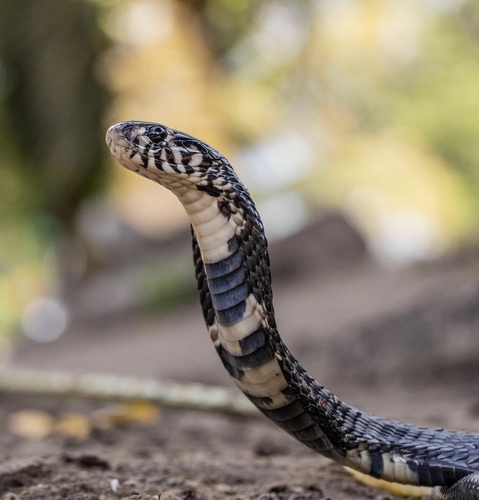
Forest Cobra
Naja melanoleuca
Meet Africa's largest cobra, a glossy-scaled giant that feels as at home in the treetops as it does in the water. With its striking 'black and white' lips and impressive length, the Forest Cobra is a master of the tropical undergrowth.
Quick Identification
Size
Typically 1.4 to 2.2 m (4.6 to 7.2 ft), with record lengths reaching up to 3.2 m (10.5 ft). They usually weigh between 1 and 3.5 kg (2.2 to 7.7 lbs).
Colors
Glossy black or dark brownish-gray on the back with a cream or white belly; distinctive black-edged labial scales (lips) create a 'barcoded' appearance.
Key Features
- Distinctive black and white barring on the labial scales (lips)
- Large, broad head with a prominent hood when threatened
- Glossy black or dark brown dorsal scales with a pale underside
- Thick, muscular body reaching up to 10 feet in length
When You’ll See Them
Geographic range
Where Does the Forest Cobra Live?
The Forest Cobra is a native powerhouse of the African continent, primarily distributed throughout Central and Western Africa. Its core range stretches from Senegal in the west across the lush Congo Basin and into parts of East Africa, including Uganda, Kenya, and western Tanzania. Thriving in high-moisture environments, this species is most commonly found in the tropical belt where dense canopy cover and permanent water sources are abundant.
Basemap © OpenStreetMap contributors
Behavior
Forest Cobras are highly adaptable and agile elapids known for their alertness. While primarily terrestrial, they are excellent swimmers and often hunt in or around water, sometimes staying submerged for several minutes. They are also surprisingly proficient climbers, frequently scaling trees to raid bird nests or find refuge in hollow trunks. Despite their fearsome reputation, they are generally shy and will attempt to flee from human contact; however, if cornered, they stand their ground with a classic cobra hood spread and a loud, intimidating hiss.
Unlike many other cobras, the Forest Cobra is often described as one of the more intelligent and curious snake species. They have a flexible activity cycle, shifting between diurnal and nocturnal patterns depending on the local environment and temperature. Their high metabolism means they are active hunters, constantly on the move through the undergrowth or along riverbanks in search of prey.
EverydayEarth exclusive
Camera Tips
To capture a Forest Cobra on camera, placement near water is your absolute best strategy. These snakes are highly semi-aquatic and frequently hunt for fish and amphibians. Setting your AI-powered camera along the muddy banks of a stream, pond, or even a permanent drainage ditch near a forest edge will yield the best results. Position the camera very low to the ground—no more than 12-18 inches high—and angle it slightly downward to ensure you catch the movement of a slithering body rather than just a blurry tail passing by. Use a wide-angle lens setting if available to capture the full length of this massive species.
Forest Cobras are attracted to areas with high rodent and amphibian activity. If you are placing cameras on a larger property or trail, look for hollow logs, brush piles, or the base of large buttress trees, which they use as dens or hunting grounds. While we don't recommend using artificial lures, maintaining a small garden pond or a consistently damp area naturally draws in their prey, making it a 'hotspot' for the cobra to visit. Be sure to use a high-speed trigger setting; while they may bask slowly, they strike and move with incredible speed when hunting.
Timing is flexible because they are active both day and night, but the early morning hours and the late afternoon 'golden hour' are when they are most photogenic. During the heat of the day, look for shaded, humid spots or heavy leaf litter. In suburban or plantation settings, they often frequent 'edge' habitats where the forest meets a clearing. Always ensure your camera is well-camouflaged and scent-free; while they aren't as shy as some smaller snakes, their keen eyesight and flicking tongues can make them wary of strange, metallic objects in their environment.
Similar Species
Species that look similar or are commonly confused with Forest Cobra.
Black-necked Spitting Cobra
Smaller in size and capable of spitting venom; lacks the high-contrast black and white barred lip scales of the Forest Cobra.
Egyptian Cobra
Typically found in drier savannas and semi-deserts; it has a more teardrop-shaped mark under the eye and lacks the Forest Cobra's glossy black finish.
Frequently Asked Questions
Record Forest Cobra at your habitat
Connect a camera to start building your own species record — AI identifies every visitor automatically.