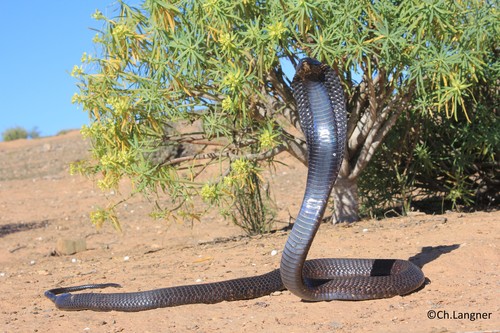
Egyptian Cobra
Naja haje
The Egyptian Cobra is a legendary predator of the African landscape, celebrated for its iconic hood and historical ties to ancient pharaohs. A master of stealth and survival, this potent serpent is a vital part of the ecosystem, keeping rodent and amphibian populations in check.
Quick Identification
Size
Average length of 1.4 m (4.6 ft), with large specimens reaching up to 2.59 m (8.5 ft)
Colors
Varied coloration ranging from solid straw-yellow and copper to greyish-brown or black; often features a dark 'tear-drop' mark below the eye
Key Features
- Distinctive broad hood that expands when threatened
- Large, dark eyes with round pupils
- Smooth, glossy dorsal scales
- Solid, stocky body build compared to other African cobras
When You’ll See Them
Geographic range
Where Does the Egyptian Cobra Live?
The Egyptian Cobra is native to the African continent, where it maintains a massive footprint across Northern Africa, from Morocco to Egypt. Its range extends south through the Horn of Africa into Kenya and Tanzania, and it is also found in isolated populations across the Arabian Peninsula. These adaptable serpents thrive in a variety of landscapes but are most frequently encountered in the fertile regions surrounding the Nile River and coastal Mediterranean shrublands.
Basemap © OpenStreetMap contributors
Behavior
The Egyptian Cobra is a terrestrial and primarily nocturnal hunter, though it can frequently be seen basking in the sun during the early morning hours. When it feels threatened, it adopts an iconic defensive posture: lifting the front third of its body off the ground and spreading its broad cervical ribs to create a wide, intimidating hood. Unlike some of its relatives, it does not 'spit' venom but relies on a potent neurotoxic bite to subdues its prey.
These snakes are highly intelligent and opportunistic, often living in close proximity to human settlements where prey is abundant. While generally avoidant of people, they will stand their ground and strike repeatedly if cornered. Historically, this species held great cultural significance, famously appearing as the 'uraeus' symbol on the crowns of ancient Egyptian pharaohs and being the rumored agent of Cleopatra's death.
EverydayEarth exclusive
Camera Tips
To successfully capture an Egyptian Cobra on a trail camera, placement is everything. These snakes are terrestrial and prefer to travel along 'corridors' such as the edges of garden walls, long grass borders, or fallen logs. Position your camera very low—ideally only 4 to 8 inches off the ground—and angle it slightly downward. Setting the camera at a 45-degree angle to a known path rather than perpendicular will give the trigger more time to fire as the snake moves through the frame.
Since cobras are frequently attracted to water in arid environments, placing your camera near a backyard pond, a leaky irrigation pipe, or a birdbath can yield excellent results. They are also highly attracted to areas with high rodent activity. If you have a woodpile or a compost heap that attracts mice and rats, this is a prime location for a 'cobra cam.' Just ensure the camera is placed in a spot with enough clearance so that moving grass doesn't cause false triggers.
Because the Egyptian Cobra is primarily nocturnal, your camera’s Infrared (IR) performance is critical. Use a camera with a 'No-Glow' IR flash to avoid startling the snake, which might cause it to flee or strike at the device. Set your camera to take short video clips (10-15 seconds) with a minimal trigger delay; a snake's fluid motion is much more impressive on video than in a still photo, and it helps in identifying the species by its movement and hooding behavior.
Safety must be your top priority. Never check or move your camera at night in known cobra territory without a high-powered flashlight and thick, snake-proof boots. If you spot a cobra on your footage, remember that they often use the same retreat—such as a hole under a porch or a gap in a stone wall—for weeks at a time. Always use a long stick or a reaching tool to clear debris around your camera before touching it to ensure a snake isn't resting directly beneath or behind the unit.
Similar Species
Species that look similar or are commonly confused with Egyptian Cobra.
Snouted Cobra
The Snouted Cobra has a prominent, enlarged scale on the end of its snout and often features bold, high-contrast banding.
Red Spitting Cobra
Typically much smaller and reddish in color, this species can spray venom from its fangs, which the Egyptian Cobra cannot do.
Forest Cobra
The Forest Cobra is more slender, highly glossy, and prefers densely forested or wooded habitats compared to the drier preferences of the Egyptian Cobra.
Frequently Asked Questions
Record Egyptian Cobra at your habitat
Connect a camera to start building your own species record — AI identifies every visitor automatically.