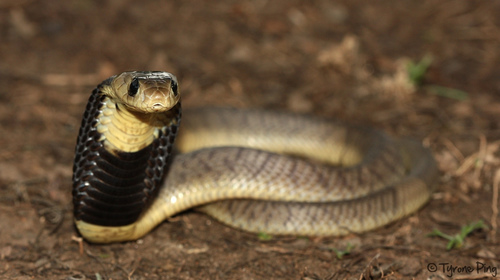
Snouted Cobra
Naja annulifera
A powerful icon of the African savanna, the Snouted Cobra is a master of adaptation, famous for its bold bands and striking defensive hood.
Quick Identification
Size
Typically 1.2–1.8 metres (4–6 feet), but exceptional males can reach 2.5 metres (8.2 feet).
Colors
Highly variable; the 'banded phase' features broad, alternating blue-black and yellowish-brown rings, while the 'plain phase' is a uniform copper-brown or grey-brown. Both phases usually have a dark band on the throat.
Key Features
- Prominent, enlarged 'snout' scale on the nose
- Impressive hood that is narrower than a spitting cobra's
- Dark teardrop-like mark below the eye
- Large, robust body with smooth scales
When You’ll See Them
Geographic range
Where Does the Snouted Cobra Live?
The Snouted Cobra is a signature species of the Southern African subcontinent, where it thrives in the hot, semi-arid interior. Its core range extends across the northern provinces of South Africa, throughout Zimbabwe and Botswana, and into southern Mozambique and Malawi. While it is most at home in the wild bushveld, it is a highly adaptable snake that has successfully moved into suburban smallholdings and farmsteads where water and rodents are plentiful.
Basemap © OpenStreetMap contributors
Behavior
The Snouted Cobra is a versatile and formidable predator that splits its time between the ground and the trees. While primarily terrestrial, it is an agile climber and will often ascend trees to raid bird nests for eggs and chicks. It is somewhat unique among cobras for being active both during the day and at night, though it prefers to bask in the morning sun to regulate its body temperature before beginning its hunt.
When threatened, this species is famous for its dramatic defensive display. It will raise the front third of its body off the ground, spread a long, impressive hood, and hiss loudly. Unlike the Mozambique Spitting Cobra, it cannot spit its venom; it relies on a potent neurotoxic bite to subdue prey or defend itself. Despite their fearsome reputation, they are generally shy and will choose flight over fight if given an escape route.
EverydayEarth exclusive
Camera Tips
To capture high-quality footage of a Snouted Cobra, focus your camera placement on 'travel corridors' and thermoregulation spots. These snakes are creatures of habit and will often return to the same flat rock or concrete slab to bask in the mid-morning sun. Position your camera about 30cm (1 foot) off the ground, angled slightly downward, to capture the full length of the snake and its characteristic movement. Because they are often active at night, ensure your camera has a high-quality infrared flash that won't overexpose the reflective scales of the snake.
Abandoned termite mounds and rock piles are the 'apartment blocks' of the bushveld. If you spot a mound with smoothed-out entrance holes, there is a high probability a cobra is using it as a retreat. Set your camera facing the most active-looking hole. Since reptiles are cold-blooded, traditional PIR (Passive Infrared) sensors can sometimes struggle to trigger. Using a camera with a high-sensitivity setting or a 'Time Lapse' mode that takes a photo every 30 seconds can significantly increase your chances of catching a passing cobra.
Water is a massive draw for this species, especially in drier regions. A backyard pond or even a low bird bath will attract not only the cobra but also its favorite prey, such as toads. Placing a camera near a water source is perhaps the most reliable way to document their presence. Always remember to maintain a safe distance when checking your camera; if you see a cobra in the area, wait for it to move on naturally. Their venom is medically significant, so 'no-touch' observation is the golden rule for backyard citizen scientists.
Similar Species
Species that look similar or are commonly confused with Snouted Cobra.
Frequently Asked Questions
Record Snouted Cobra at your habitat
Connect a camera to start building your own species record — AI identifies every visitor automatically.