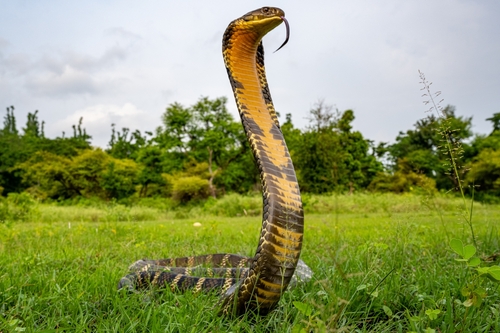
Northern King Cobra
Ophiophagus hannah
The undisputed king of the jungle floor, the Northern King Cobra is an intelligent, nest-building giant. As the world's longest venomous snake, it commands respect with its iconic hood and specialized diet of fellow serpents.
Quick Identification
Size
Length typically 3.18 to 4 m (10.4 to 13.1 ft), reaching a record of 5.85 m (19.2 ft); weight 6 to 12 kg (13.2 to 26.4 lbs).
Colors
Olive-green, tan, or black with pale yellow or white crossbands along the body; cream or pale yellow belly; juveniles are jet black with bright yellow bands.
Key Features
- Iconic narrow hood that expands when threatened
- Large 'occipital' scales on the back of the head
- Distinctive deep, guttural hiss that sounds like a growl
- The world's longest venomous snake
When You’ll See Them
Geographic range
Where Does the Northern King Cobra Live?
The Northern King Cobra is native to the vast tropical regions of South and Southeast Asia, stretching from the Indian subcontinent through Indochina to Southern China. It is commonly found in the lush jungles of Thailand, Vietnam, Malaysia, and the Philippines, as well as the dense forests of the Western Ghats in India. While they are forest specialists, they are increasingly seen in agricultural areas and tea plantations that have replaced their natural habitat.
Basemap © OpenStreetMap contributors
Behavior
The Northern King Cobra is an apex predator known for its remarkable intelligence and complex behaviors that set it apart from other snakes. Unlike most serpents, they are primarily diurnal, hunting during the day and resting at night. They are famously the only snake species in the world that builds a dedicated nest for its eggs; the female uses her body to coil around leaf litter, creating a mound where she stays to guard the clutch until they hatch. This maternal instinct is a rarity in the reptile world.
While they possess a fearsome reputation, King Cobras are generally shy and will avoid human confrontation whenever possible. When cornered, however, they can lift up to one-third of their body off the ground—standing eye-to-eye with a human—and expand their hood while emitting a low-frequency growl. They are solitary hunters but exhibit fascinating courtship rituals where males engage in non-venomous wrestling matches to win the right to mate with a female.
EverydayEarth exclusive
Camera Tips
Capturing the world's longest venomous snake on camera requires a strategic approach focused on 'corridors.' King Cobras are highly active foragers that often follow the same routes through leaf litter or along the banks of forest streams. Position your trail camera low to the ground—about 10 to 15 inches high—and angle it slightly downward. Focus on areas with fallen logs, bamboo clumps, or the edges of water bodies where their prey (other snakes) are likely to be found. Because they are diurnal, ensure your camera has a fast trigger speed to capture them in the daylight without motion blur.
Standard baits like meat or fruit will not work for this species as they are strict carnivores focused on reptilian prey. Instead, 'natural lures' are your best bet. If you find a shed snake skin or a known burrow for rat snakes, these are high-traffic areas for a hunting King Cobra. During the nesting season (typically March to May), keep a lookout for large mounds of dried leaves. Placing a camera 15-20 feet away from a suspected nest can capture incredible footage of the female's protective behavior, but never approach a nest too closely as they are extremely defensive during this period.
For camera settings, use a wide-angle lens if available. A King Cobra's length is its most striking feature, and a narrow field of view may only capture a fraction of its body as it glides past. Set your camera to record short video clips (15-30 seconds) rather than just stills, as the fluid, rhythmic movement of a King Cobra is one of the most majestic sights in the wild. Always remember: these are highly dangerous animals. Use a long reach tool to adjust your camera and never set up gear in a way that requires you to reach into dark crevices or thick undergrowth where a snake might be resting.
Similar Species
Species that look similar or are commonly confused with Northern King Cobra.
Frequently Asked Questions
Record Northern King Cobra at your habitat
Connect a camera to start building your own species record — AI identifies every visitor automatically.