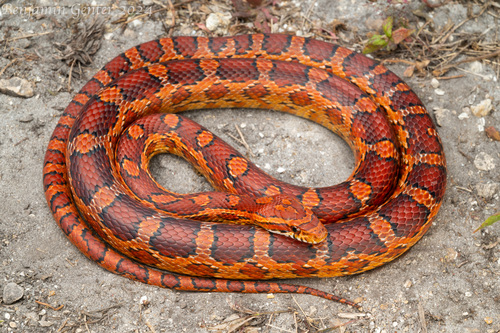
Red Cornsnake
Pantherophis guttatus
Vibrantly colored and exceptionally gentle, the Red Cornsnake is a master climber and a friend to gardeners. This non-venomous hunter is often the 'secret' protector of backyards, keeping rodent populations in check with quiet efficiency.
Quick Identification
Size
Adults typically range from 61 to 182 cm (24 to 72 inches) in length, with a slender build weighing between 250 and 800 grams.
Colors
Bright orange to brownish-yellow ground color with large, dark-edged red or orange 'saddles' along the back; belly features a distinctive black-and-white 'maize' checkered pattern.
Key Features
- Distinctive 'V' or spearhead marking on top of the head
- Black-and-white checkered belly pattern resembling Indian corn
- Smooth scales with large, reddish-orange dorsal blotches outlined in black
When You’ll See Them
Geographic range
Where Does the Red Cornsnake Live?
Native to the North American continent, the Red Cornsnake is primarily found throughout the southeastern and central United States. Its core range extends from southern New Jersey southward to the Florida Keys and westward into Louisiana and parts of Kentucky. While they are most abundant in the Atlantic coastal plain, they have also established localized populations in some Caribbean islands where they were likely introduced through the pet trade.
Basemap © OpenStreetMap contributors
Behavior
Red Cornsnakes are primarily solitary and secretive creatures that spend much of their time hidden under logs, bark, or in abandoned rodent burrows. While they are highly capable climbers—often seen ascending trees or building rafters in search of bird nests—they are most frequently found on the ground. During the cooler spring and autumn months, they may be active during the day, but they shift to a crepuscular or nocturnal lifestyle during the height of the summer heat to avoid extreme temperatures.
When encountering humans, these snakes are generally docile and will attempt to flee rather than fight. If cornered, they may vibrate their tails in leaf litter to produce a buzzing sound that mimics a rattlesnake, a defensive bluff designed to ward off predators. Because they are non-venomous constrictors, they pose no threat to people or pets and are actually highly valued by homeowners for their ability to naturally control mouse and rat populations around gardens and outbuildings.
EverydayEarth exclusive
Camera Tips
To capture high-quality footage of a Red Cornsnake, camera placement is critical. Because these snakes are low-profile and often travel along 'edges,' position your camera just 3 to 6 inches off the ground. Aim the lens along the base of a stone wall, a fallen log, or the edge of a garden bed where the lawn meets thick brush. These are natural travel corridors for snakes moving between hunting grounds and shelter.
Standard PIR (Passive Infrared) sensors on many trail cameras can struggle to detect cold-blooded reptiles since they rely on heat signatures. To overcome this, use a 'Time-Lapse' mode if available, setting the camera to take a photo every 15–30 seconds during their peak activity hours at dawn and dusk. If your camera has sensitivity settings, turn them to 'High' to increase the chance of the sensor picking up the slight temperature difference between the snake and the ground.
Luring a Red Cornsnake doesn't require food; instead, provide structural 'props.' A piece of old plywood or a flat rock placed in a sunny but sheltered spot can act as a basking site. If you place your camera facing this 'cover object,' you are likely to catch the snake as it emerges to warm up or as it ducks underneath for safety. During the mid-summer, focus your efforts on the hours just after sunset when the pavement or soil is still warm, as snakes will often linger in these areas to maintain their body temperature.
Finally, ensure your camera has a close-focus capability or use a macro lens attachment if possible. Since Cornsnakes are relatively small compared to deer or bears, a camera that is too far away will only capture a blurry orange streak. Aim for a focal distance of 3 to 5 feet to get those crisp shots of their intricate scale patterns and flickering tongues.
Similar Species
Species that look similar or are commonly confused with Red Cornsnake.
Frequently Asked Questions
Record Red Cornsnake at your habitat
Connect a camera to start building your own species record — AI identifies every visitor automatically.