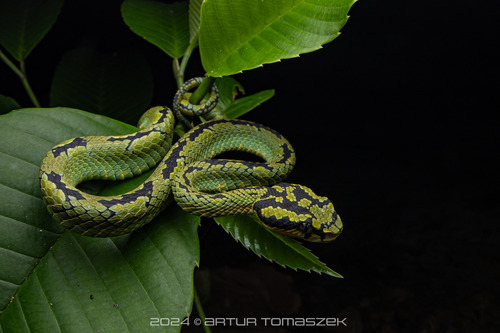
Sri Lankan Green Pit Viper
Craspedocephalus trigonocephalus
An emerald jewel of the island, the Sri Lankan Green Pit Viper is a master of camouflage found nowhere else on Earth. With its striking triangular head and heat-sensing pits, it is one of Sri Lanka's most iconic and beautiful venomous reptiles.
Quick Identification
Size
Total length typically 60–75 cm (24–30 inches), though large females can reach up to 130 cm (51 inches).
Colors
Bright green to lime-yellow base color with a black or dark brown variegated pattern on the dorsal side. A distinct black stripe runs behind the eye, and the tail tip is usually dark brown or black.
Key Features
- Broad triangular head distinct from the neck
- Heat-sensing loreal pits between eyes and nostrils
- Vibrant green body with black zig-zag or mottled patterns
- Prehensile tail used for gripping branches
When You’ll See Them
Geographic range
Where Does the Sri Lankan Green Pit Viper Live?
This striking serpent is a true island specialist, found exclusively on the island of Sri Lanka. It thrives across the wet zone and intermediate zones, ranging from the humid lowlands up into the mist-shrouded central highlands. While it is most concentrated in lush rainforests and mountainous regions, it is frequently encountered in the well-vegetated gardens and estates that border these natural habitats.
Basemap © OpenStreetMap contributors
Behavior
The Sri Lankan Green Pit Viper is a sluggish, arboreal predator that spends the vast majority of its life elevated in the forest canopy or dense shrubbery. As a 'sit-and-wait' specialist, it remains motionless for extended periods, perfectly camouflaged against green foliage. While it is active primarily at night, it is frequently encountered during the day resting on low-hanging branches, where it relies on its cryptic coloration to avoid detection.
Despite being a venomous species, it is generally slow-moving and non-aggressive unless directly threatened or stepped upon. When hunting, it uses its heat-sensing pits to detect the infrared signatures of warm-blooded prey in total darkness. It is a solitary creature, usually only seen with others during the mating season, and it gives birth to live young rather than laying eggs.
EverydayEarth exclusive
Camera Tips
To capture the Sri Lankan Green Pit Viper on camera, placement is the most critical factor. Since they are highly arboreal, do not place your camera at ground level. Instead, mount your camera between 3 to 6 feet high, angled slightly downward toward low-hanging branches or dense shrubs. They are particularly fond of tea bushes and ornamental plants like Hibiscus in backyard gardens, where they wait for geckos or small rodents. Use a macro-capable lens or a camera with a short focal distance if possible, as these snakes are often stationary and very close to the foliage.
Lighting and triggers are your biggest technical challenges. Because this species is nocturnal and relies on camouflage, a high-quality infrared (IR) flash is essential to avoid washing out its vibrant green color or scaring it off with a bright white light. Setting your camera to 'Time-Lapse' mode at 5-minute intervals can be more effective than motion triggers; because these snakes sit perfectly still for hours, they often fail to activate standard PIR sensors. Look for spots near outdoor lights that attract moths and lizards, as the viper will often set up an ambush site nearby to take advantage of the prey traffic.
Safety should be your top priority when checking your gear. Always use a long stick to check the area around your camera before reaching in, as these snakes are master mimics of green leaves and can be easily missed. Wear thick gloves and long sleeves when mounting equipment in dense Sri Lankan foliage. Avoid using food bait, as it rarely works for sit-and-wait predators; instead, focus on habitat features like small garden ponds or areas with high lizard populations to increase your chances of a successful capture.
Similar Species
Species that look similar or are commonly confused with Sri Lankan Green Pit Viper.
Green Vine Snake
The Vine Snake has an extremely elongated, pointed snout and a very slender body, whereas the Pit Viper has a broad, triangular head.
Hump-nosed Viper
The Hump-nosed Viper is typically brown or grey and stays on the ground, whereas the Green Pit Viper is bright green and lives in trees.
Frequently Asked Questions
Record Sri Lankan Green Pit Viper at your habitat
Connect a camera to start building your own species record — AI identifies every visitor automatically.