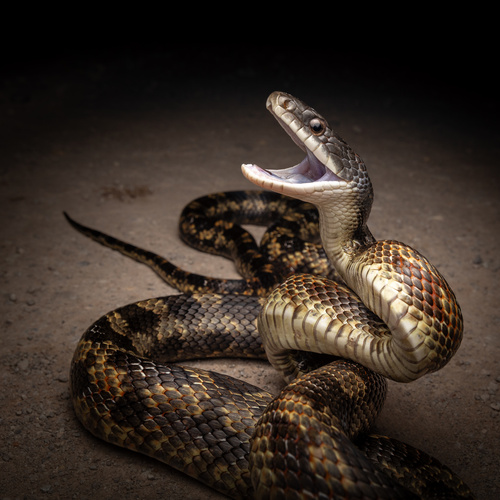
Western Ratsnake
Pantherophis obsoletus
The Western Ratsnake is North America's master climber, a powerful and harmless constrictor that serves as an essential guardian of the ecosystem by keeping rodent populations in check.
Quick Identification
Size
3.5 to 6 feet (107–183 cm) on average; can reach up to 8 feet (244 cm). Weight typically 1.1 to 4.9 lbs (0.5–2.2 kg).
Colors
Adults are typically solid black or dark brown on top, sometimes with faint traces of a blotched pattern. The chin and throat are white or cream, and the belly is white or yellow with dark checkerboard markings.
Key Features
- Large, powerful body with a cross-section shaped like a loaf of bread
- Weakly keeled (ridged) scales that feel slightly rough
- White or cream-colored chin and throat contrasting with a dark head
- Highly proficient climber often found high in trees
When You’ll See Them
Geographic range
Where Does the Western Ratsnake Live?
Native to North America, the Western Ratsnake is a dominant presence across the central United States, primarily found west of the Mississippi River. Its core range spans from the southern reaches of Canada in Ontario, down through the Great Plains and Midwestern states like Missouri, Kansas, and Oklahoma, extending as far south as central Texas and northeastern Mexico. Because they are so adaptable, these snakes are frequently encountered in a variety of environments, ranging from the rugged Ozark plateaus to the sprawling suburban landscapes of the American heartland.
Basemap © OpenStreetMap contributors
Behavior
The Western Ratsnake is a docile yet formidable constrictor known for its incredible climbing ability. Often referred to as 'nature's pest control,' these snakes spend a significant amount of time off the ground, scaled up trees or rafters in search of bird nests and rodents. While they are primarily active during the day (diurnal) in the mild temperatures of spring and autumn, they often shift to a nocturnal lifestyle during the sweltering heat of the summer months to avoid the midday sun.
When threatened, the Western Ratsnake has a unique defensive repertoire. It will often 'kink' its body, remaining perfectly still to resemble a fallen branch. If further provoked, it may vibrate its tail rapidly against dry leaves, creating a buzzing sound that mimics a rattlesnake, and release a pungent musk from its cloaca to deter predators. Despite these displays, they are non-venomous and generally choose flight over fight when encountering humans.
EverydayEarth exclusive
Camera Tips
Capturing a Western Ratsnake on camera requires a different strategy than mammals because they are ectothermic (cold-blooded). Standard PIR (Passive Infrared) motion sensors on trail cameras often fail to trigger for snakes because they don't produce enough heat. To bypass this, set your AI-powered camera to 'Time-Lapse' mode or 'Hybrid' mode with a short interval (e.g., every 1-5 minutes) during peak activity hours in the morning or late afternoon.
Placement is everything for this arboreal species. While ground-level shots are great for 'cruising' behavior, you will have more success mounting your camera 4-6 feet high on a tree trunk looking downward, or along a horizontal fence rail. These snakes love to use human structures as highways, so pointing a camera at the top of a stone wall or the wooden beams of an old shed or barn is a prime location for high-quality footage.
Focus your efforts near 'attractants' rather than using bait. Western Ratsnakes are naturally drawn to bird feeders (where they hunt both birds and the rodents that eat fallen seed) and brush piles. If you have a birdhouse on your property, mounting a camera nearby in early summer is a guaranteed way to see a ratsnake, as they are notorious for checking nests. Look for 'kinked' shapes in your footage, as they often freeze when they hear the camera's shutter or see movement.
During the peak of summer, switch your camera to night-vision mode. In the Southern US, these snakes are almost entirely nocturnal in July and August. Ensure your camera is equipped with 'No-Glow' or 'Low-Glow' infrared LEDs, as some studies suggest snakes may be sensitive to certain light spectrums. For the best clarity, position the camera within 3-5 feet of the expected path, as their dark bodies can be difficult to distinguish from shadows at long distances.
Similar Species
Species that look similar or are commonly confused with Western Ratsnake.
Frequently Asked Questions
Record Western Ratsnake at your habitat
Connect a camera to start building your own species record — AI identifies every visitor automatically.