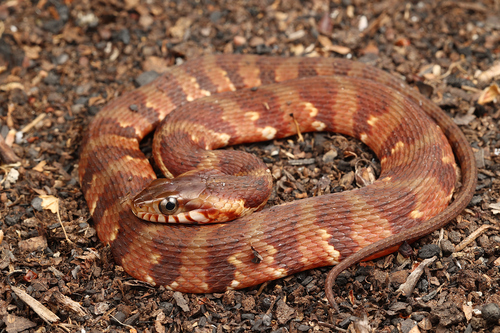
Banded Watersnake
Nerodia fasciata
A master of the Southern wetlands, the Banded Watersnake is a bold, nonvenomous hunter often seen basking near the water's edge. With its striking crossbands and aquatic agility, it is a fascinating species to discover in your backyard pond or local marsh.
Quick Identification
Size
Typically 61-107 cm (24-42 inches) in length, with exceptionally large individuals reaching up to 152 cm (60 inches).
Colors
Base color of gray, light brown, or reddish-brown with large, dark crossbands that often widen at the sides. The belly is usually creamy with red or black crescent-shaped markings.
Key Features
- Broad dark crossbands that reach the belly without breaking
- Vertical dark lines on the scales bordering the mouth (labial bars)
- Keeled, rough-textured scales
- Round pupils and large eyes relative to the head
When You’ll See Them
Geographic range
Where Does the Banded Watersnake Live?
Native to the North American continent, the Banded Watersnake is a quintessential resident of the Southeastern United States. Its core range flourishes across the coastal plains from North Carolina down through the entirety of Florida, extending westward through the Gulf States into eastern Texas and north into the Mississippi River Valley. Within these regions, they are common lowland specialists, rarely found in high-elevation mountainous terrain but thriving in almost any permanent freshwater source.
Basemap © OpenStreetMap contributors
Behavior
The Banded Watersnake is a semi-aquatic specialist that spends the majority of its life in or near freshwater. During the mild days of spring and autumn, these snakes are frequently observed basking on logs, rocks, or low-hanging branches to soak up the sun's warmth. They are wary and agile; at the slightest sign of a threat, they will quickly drop into the water and dive to the bottom to hide. While they are nonvenomous, they have a reputation for being defensive if cornered, often flattening their bodies to appear larger and releasing a foul-smelling musk to deter predators.
These snakes are primarily solitary hunters but can be found in high numbers in environments with abundant prey. Their activity patterns change with the seasons; they are diurnal during the cooler months but shift to a nocturnal lifestyle during the height of summer to avoid extreme heat. Because they frequently share the same habitats as the venomous Cottonmouth, they are often misunderstood by humans, though they play a crucial role in maintaining the balance of fish and amphibian populations in wetland ecosystems.
EverydayEarth exclusive
Camera Tips
Capturing the Banded Watersnake on a backyard camera requires a focus on the water-to-land interface. Position your camera near 'basking platforms'—flat rocks, partially submerged logs, or low branches that hang directly over the water. These are the most likely spots for a snake to remain stationary long enough for a high-quality capture. Set your camera as low as possible, ideally 6 to 12 inches off the ground, and angle it slightly downward to ensure the snake’s full body is in the frame as it crawls or basks.
Because snakes are ectothermic (cold-blooded), they do not always trigger standard PIR motion sensors that rely on heat signatures. To overcome this, use a camera with high-sensitivity motion settings or utilize a 'Time Lapse' mode that takes a photo every 30 to 60 seconds during peak daylight hours. If your camera is near a garden pond, you can naturally attract them by ensuring the area has plenty of cover like lily pads or rock piles, which draw in the frogs and fish they hunt. Avoid using artificial baits, as snakes respond more to the movement and scent of live prey.
Visibility is key, so clear away tall grass or reeds that might sway in the wind and cause false triggers or obscure the snake's intricate banding patterns. Video mode is highly recommended for this species; it allows you to see their unique rhythmic 'S' swimming motion and their tongue-flicking behavior. During the summer, switch to a high-quality infrared (IR) flash setup, as the snakes will become much more active after dark to hunt in the shallows.
Similar Species
Species that look similar or are commonly confused with Banded Watersnake.
Common Watersnake
The crossbands on a Common Watersnake usually break up into alternating blotches toward the tail, while the Banded Watersnake's bands remain complete.
Northern Cottonmouth
Cottonmouths are venomous with a thick body, vertical pupils, and a heat-sensing pit between the eye and nostril.
Brown Watersnake
This species has a more 'neckless' appearance and features square-shaped blotches along the back rather than continuous bands.
Frequently Asked Questions
Record Banded Watersnake at your habitat
Connect a camera to start building your own species record — AI identifies every visitor automatically.